Turning Existing CCTV into a Safety System: A Practical Guide for Oil & Gas HSE Teams
Most oil and gas facilities already have more safety-relevant footage than any human team could ever watch. Cameras cover the fence line, the process areas, the loading racks, the walkways. And almost all of that footage does exactly one thing: it records what already happened, so someone can review it after an incident.
The gap between "we have cameras everywhere" and "our cameras help prevent harm" is the subject of this guide. You do not close it by buying more cameras. You close it by making the ones you have intelligent.
From recording to watching
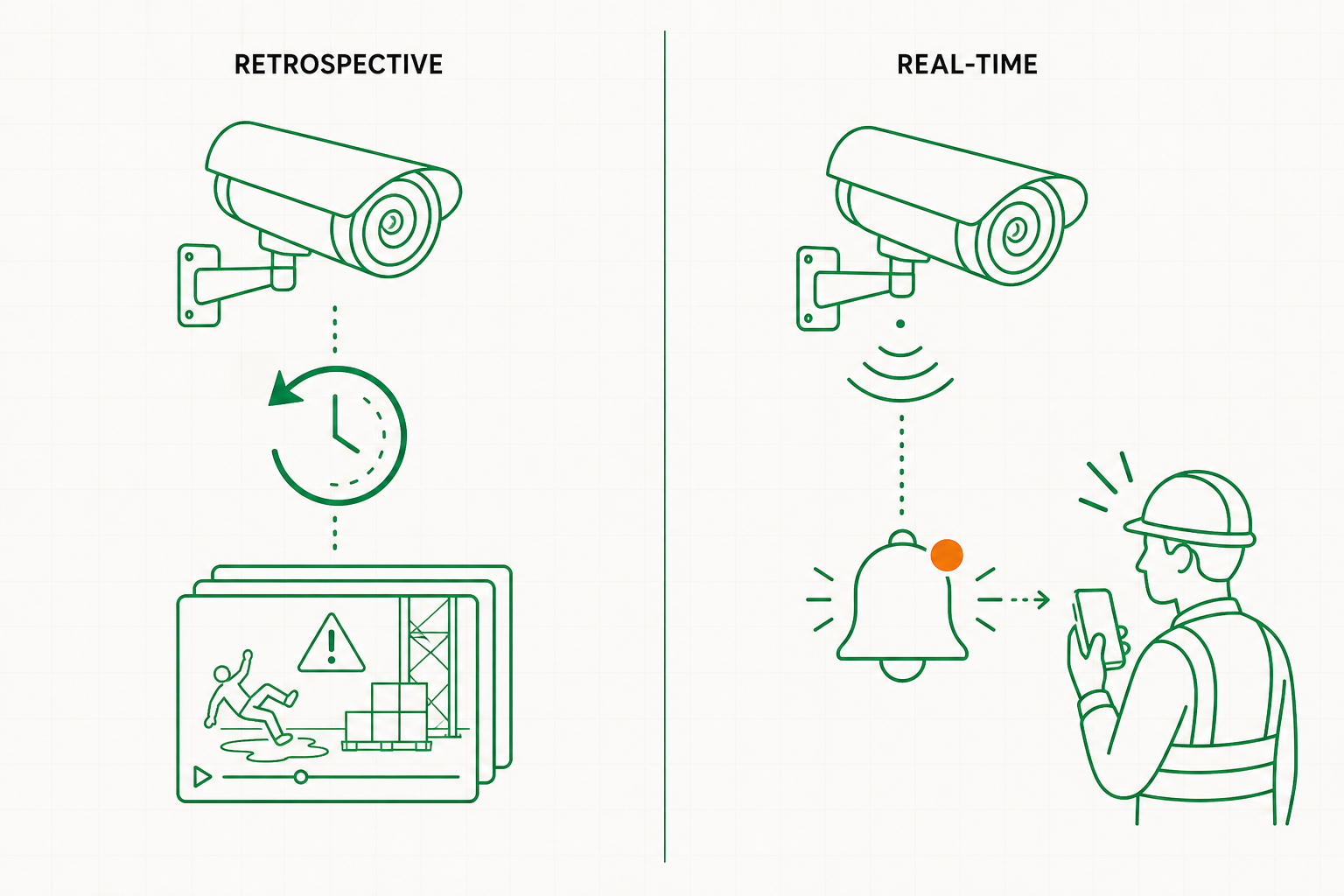
A conventional CCTV estate is a recording system. You look at it when something has gone wrong. An AI safety layer turns that same estate into a watch: a system that continuously reads the feeds and surfaces the moments that matter while there is still time to act on them.
The shift is from retrospective to real-time. Instead of pulling footage after a person is hurt, the system flags the missing hard hat, the person in a restricted zone, the closing distance between a worker and a moving excavator, or the early signature of fire or a spill, in the moment, to the person who can intervene.
Crucially, this is a software change, not a hardware project. If it were a rip-and-replace of your camera estate, it would never survive a budget review or an OT security review in a safety-critical environment. The whole point is that it runs on what you already own.
How it actually works
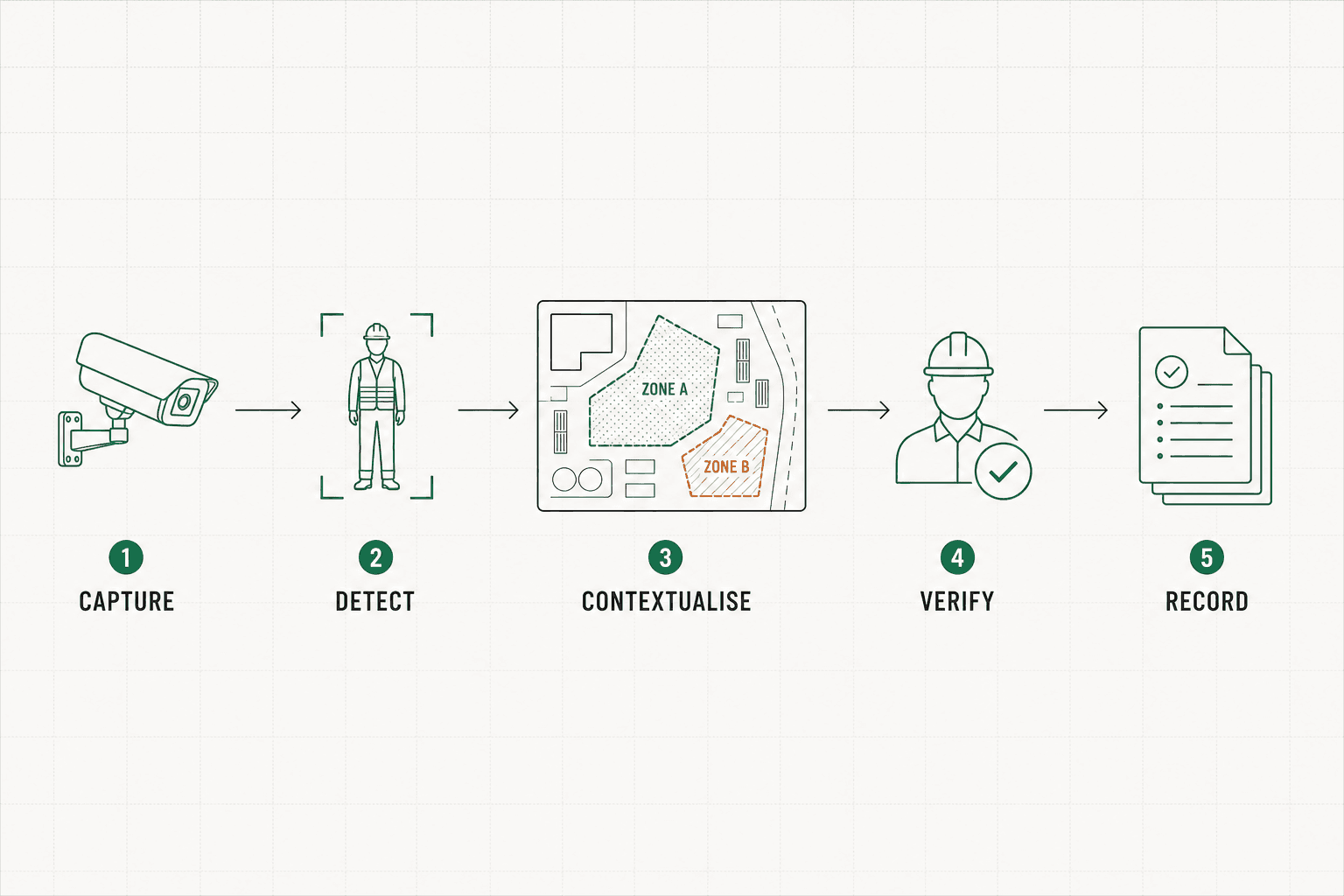
You do not need to be an engineer to evaluate this, but you should understand the shape of the pipeline, because the shape is where the good and bad systems separate.
1. Capture: connect to the cameras you already run
Modern IP cameras stream over standard protocols: RTSP and ONVIF. An AI safety layer connects to those existing streams rather than replacing anything. In practice, an on-site appliance ingests the feeds. No new cameras, no cabling project, no parallel estate. This is the difference between a pilot that starts next week and a capital project that starts next year.
2. Detect: models read the feed continuously
Computer vision models analyse the video for the things human supervisors cannot reliably track across dozens of screens and thousands of hours: PPE gaps, people in zones they should not be in, unsafe proximity to equipment, work at height, missing barriers, overcrowding, fire and smoke, spills, a person down, near-misses. Good systems detect both the presence and the absence of things. A worker without a hard hat is flagged as confidently as one wearing it.
3. Contextualise: the system understands the site, not just the pixels
This is the step that separates a useful system from an alarm that everyone learns to ignore. A missing hard hat in a general walkway is not the same event as a missing hard hat inside a hot-work area. A serious system lets you draw zones (restricted, hazardous, hot-work, confined-space, muster) and attach rules to each: what PPE is required where, what proximity is unsafe, what severity applies. The system then combines the raw detection with location, motion, and your own policy to decide whether something actually matters.
4. Verify: a human stays at the centre
In a safety-critical operation, models should propose and accountable people should decide. The best deployments route a short evidence clip to a human reviewer who confirms, dismisses, or escalates. Critical events like fire, spills, and person-down never silently close themselves. This human-in-the-loop design is not a limitation; it is what makes operations teams trust the system enough to act on it.
5. Record: the evidence carries through to compliance
Every verified event should carry its timestamp, location, and visual evidence into an append-only record. That record is what turns a safety system into a compliance asset: incident reports, near-miss logs, and regulatory filings that are built from verified events rather than reconstructed from memory two weeks later.
What to ask before you buy
If you take one thing from this guide into a vendor conversation, make it this checklist. These are the questions that expose whether a system was built for a real industrial site or demoed on a clean one.
Does it run on our existing cameras? If the answer involves proprietary hardware or specific camera models, the deployment cost and lock-in are higher than the sticker suggests. Look for RTSP/ONVIF support and camera-agnostic ingestion.
Where does inference run, and where does data live? Many oil and gas sites are remote, with unreliable connectivity, and many run conservative OT security reviews. Edge or on-prem inference, where video is processed on-site and raw footage never has to leave the network, is often non-negotiable. Ask specifically whether the system can run air-gapped, and what, if anything, leaves the site.
How does it handle false alarms? This is the number-one reason safety AI fails in the field: alerts that are wrong often enough that crews stop trusting them. Ask how the system uses context (zones, policy, visibility) to suppress noise, and whether it avoids guessing when a body part simply is not visible in frame.
Is there a human in the loop for critical events? A system that auto-closes a fire detection is a liability. A system that routes it to a reviewer is an asset.
Does it produce records you can actually file? Detection is table stakes. The value is in whether verified events become audit-ready records, and, if you operate in Nigeria, whether those records map to what NOSDRA and other regulators require.
How fast is a pilot? A serious vendor should be able to start against your highest-risk zones and your rules in days, not run a multi-month integration. "Pilot, not project" is a reasonable expectation.
What you actually get
None of this eliminates risk. No honest system promises that. What it does is move safety from investigation after the fact to intervention in the moment, and it turns footage that was previously stored and forgotten into a clear, searchable, attributable account of what is happening across a facility. For HSE leaders, that means catching the weak signals earlier, directing limited attention where it prevents the most harm, and arriving at audits and incident reviews with a record that defends itself.
The cameras are already watching. The question is only whether they are allowed to help.
MilkenLabs is an intelligence layer on the CCTV oil and gas operators already own: real-time detection of leading safety indicators, human-verified, with audit-ready records built in. Request a demo to prove the signal, the workflow, and the record against one of your own facilities.