Loading-Bay Queues, Truck Traffic, and Pedestrian Near-Misses at Nigerian Depots
If you want to see where Operations, HSE, and Security argue past each other at a Nigerian depot or terminal, stand at the loading bay for an hour. Trucks queue. Drivers leave cabs. Pedestrians cut across lanes that were empty at the morning briefing. A crane or suspended load swings through a keep-clear zone while someone walks the painted line that nobody treats as real. The cameras usually see all of it. The organisation often sees it only when someone is hurt, product is delayed, or a near-miss report is written from memory at the end of a long shift.
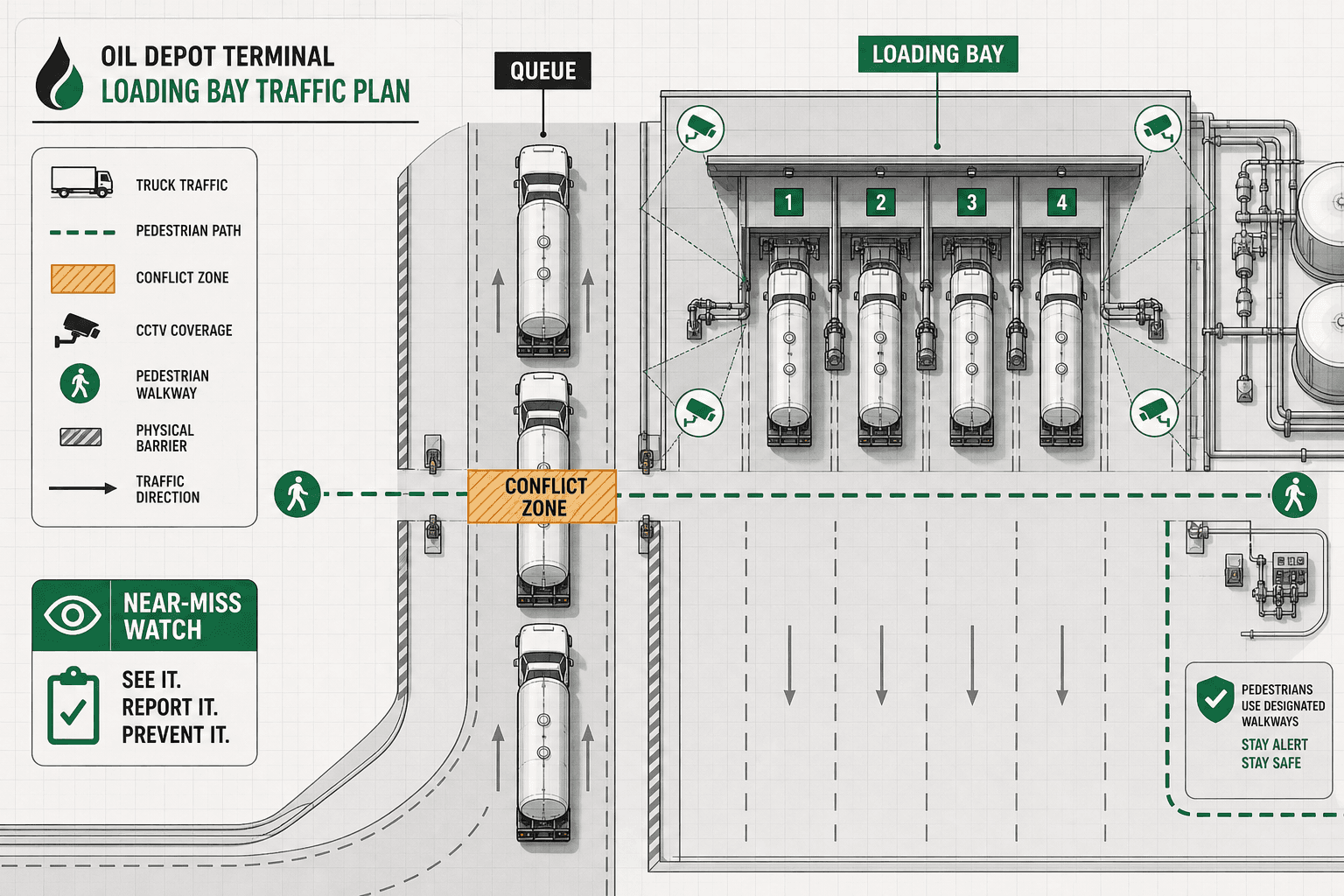
This article is about facility CCTV intelligence for loading-bay and truck-traffic risk: queue and dwell discipline, pedestrian-vehicle conflict, blocked pathways, and suspended-load awareness. It is Operations-led, HSE-critical, and Security-relevant when vehicles and people are where they should not be. It is not a claim that analytics will make a busy rack gentle. It is a claim that more of the preventable near-misses can be caught while they are still near-misses.
Why the loading bay is its own problem
Process areas have permits, PPE rules, and crews who live inside the hazard. The loading bay mixes public-facing truck traffic, contractors, temporary labour, and production pressure. The hazard picture changes every few minutes. A zone that was clear becomes a queue. A pedestrian route that was respected becomes a shortcut when the sun is high and the bay is late.
Traditional CCTV review after an incident can show what happened. It rarely changes the next hour. Continuous intelligence at the bay is useful only if it speaks the language Operations already uses: which lane is blocked, which truck has dwelled too long, which walkway is compromised, which lift has people under or near the load path.
The event set that matters
Keep the list short enough that a shift supervisor will still believe it.
Truck queue and dwell. Vehicles stacked beyond the planned holding pattern, or dwelling at a bay longer than your operating rule. This is an Operations signal first. It becomes an HSE signal when the queue pushes people and trucks into conflict zones.
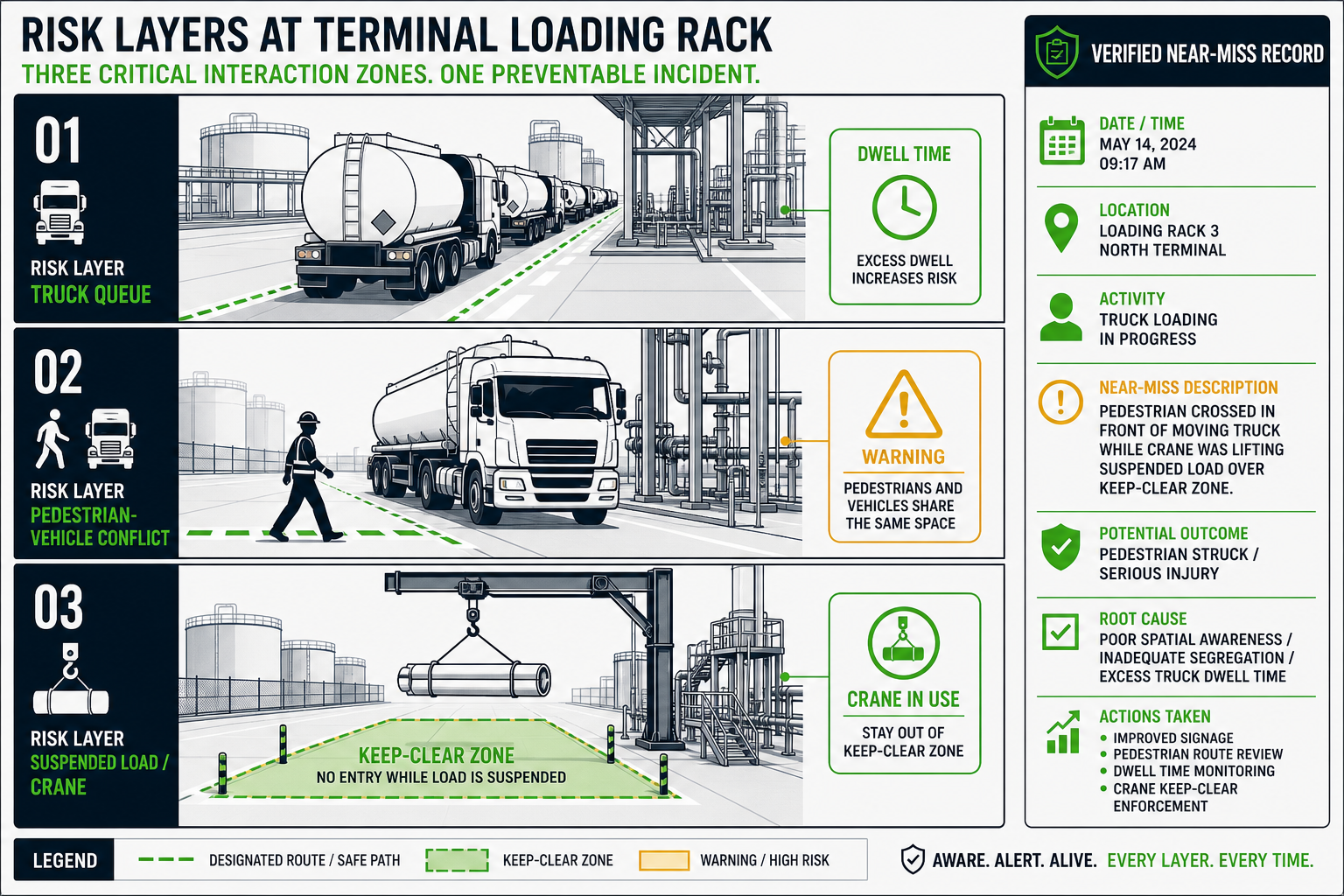
Pedestrian-vehicle near-miss patterns. People and trucks sharing space inside defined conflict polygons, especially at bay faces, crossing points, and behind reversing vehicles.
Blocked pathways and egress. Hoses, pallets, unattended objects, or vehicles sitting on routes that must stay clear for people to get out and for emergency access to get in.
Suspended load and crane work assists. People entering a keep-clear radius under or beside a suspended load. This will never replace a banksman or lift plan. It can flag when the plan on paper is not the plan in the bay.
Unauthorized vehicle presence in rack lanes. A Security and Operations overlap: the wrong vehicle in the wrong lane at the wrong time.
Near-misses only count if people report them
HSE teams know the trap. If every minor conflict becomes a bureaucratic ordeal, crews stop reporting. If analytics fire on every pedestrian who steps near a painted line, supervisors mute the system. The design answer is the same one that saves PPE programs: context and human review.
Draw conflict zones that match how the depot actually moves, not how the as-built drawing wished it moved. Set severity so a brief, resolved crossing is logged for trend while a person under a suspended load escalates now. Let a reviewer confirm before a near-miss becomes a formal record that follows someone. Models propose. Accountable people decide. Over time, the verified near-miss trend is more useful than a raw motion count, because supervisors trust it enough to change marshalling, barriers, or shift briefings.
What Operations and Security gain
A credible Operations case does not need inflated injury claims. Queue and dwell visibility helps plan bay allocation and reduce the chaos that creates risk. Blocked-egress and unattended-object events protect turnaround and emergency access. Multi-bay evidence helps a terminal manager see whether yesterday's congestion was a one-off driver problem or a systemic layout problem. Those are operational facts with safety consequences, which is the right way to talk about this investment inside a Nigerian midstream or downstream organisation answering to NMDPRA expectations for safe operation, not only to an internal HSE slogan.
Loading racks are also where product and vehicles meet the outside world. Unexpected vehicles, loitering near rack approaches, and open secondary gates during loading windows are Security events that sit on the same cameras. The practical win is one evidence timeline: the truck that entered at the gate, dwelled in the yard, and appeared at bay three is the same object Security and Operations discuss, not three spreadsheet rows that disagree.
Rolling it out without stopping the depot
Do not begin with every camera and every rule. Pick the highest-conflict bay and the main pedestrian crossing. Define two or three zones with HSE and the shift supervisors who will ignore bad alerts. Run a quiet pilot with review-queue confirmation. Tune dwell thresholds against real queue behaviour in rain, night, and peak booking windows. Only then expand to more bays and to suspended-load polygons on active crane days.
Keep inference on-site. Loading-bay video is operationally sensitive, and depots with weak connectivity cannot depend on a cloud round-trip to tell them a walkway is blocked.
What it comes down to
At Nigerian depots and terminals, the loading bay is where throughput pressure and human vulnerability share the same few metres of asphalt. Existing CCTV can do more than archive the collision. With zone context, restrained event types, and human verification, it can surface truck dwell, pedestrian-vehicle conflict, blocked egress, and suspended-load exposure while intervention is still possible. That will not make risk zero. It can make more of the preventable near-misses visible to Operations and HSE in time to change the next move, not only the next investigation.
MilkenLabs includes loading-bay and truck-traffic intelligence in its Operations pack, on the same facility CCTV layer as Security and HSE detections for oil and gas sites. Explore capabilities or request a demo.