Facility Perimeter and Gate CCTV Intelligence for Oil and Gas Sites in Nigeria
Most oil and gas facilities in Nigeria already watch their fences and gates. The cameras are there. The monitors are there. What is often missing is a clear answer after every shift or incident: did something happen at the perimeter or the gate that we should have acted on while it was still preventable?
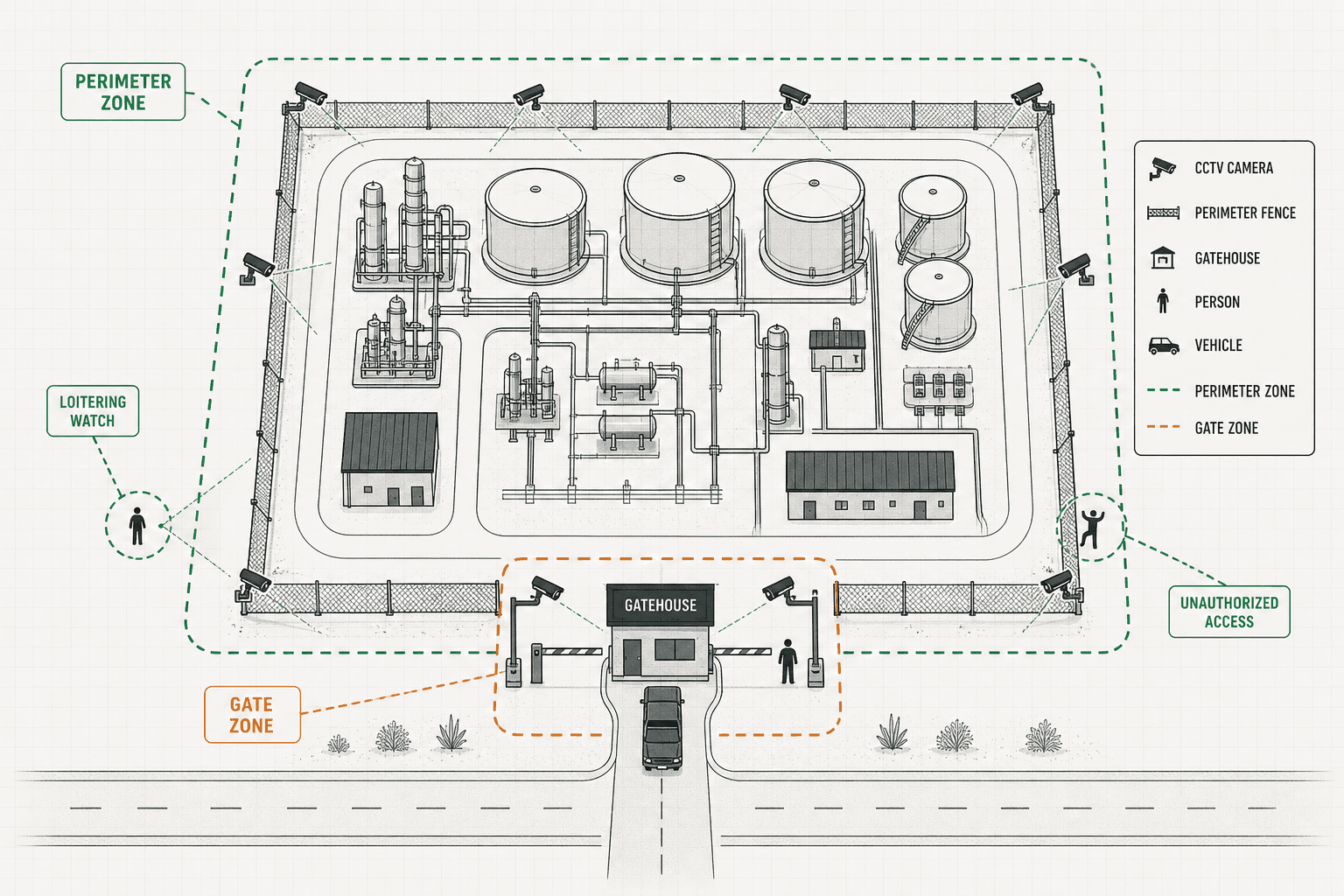
This article is for Security, HSE, and Operations leaders who run flow stations, tank farms, terminals, depots, and gatehouses. It is about facility-focused CCTV intelligence, not kilometre-scale pipeline corridor monitoring. Corridor vandalism and RoW threats are real, but they are a different problem. The work described here sits at the facility boundary you already control: the fence, the approach, the gatehouse, and the yards immediately inside.
Three teams meet at the fence
At a Nigerian site, the perimeter and gate are not "security only." Security cares about intrusion, loitering, and unauthorized access. HSE cares because an open gate, an unescorted visitor, or a person where they should not be is often the first step toward a safety event. Operations cares because gate discipline affects truck flow, contractor control, and night-shift handover trust.
When those three jobs use three different tools, or none beyond a tired eye on a wall of screens, the same camera feed produces three incomplete stories. Intelligence at the perimeter means turning that feed into events each team can review, escalate, and keep as evidence, without pretending a camera can replace a guard, a radio, or a permit system.
How most sites watch today
A typical arrangement is familiar. Cameras cover the fence and gate. A control room watches a subset of feeds. After something goes wrong, someone pulls recordings and reconstructs a timeline. Between incidents, the system is mostly archival.
That model fails in predictable ways. Attention drops on quiet nights. Loitering near a secondary gate looks like nothing until it is not. An open gate during a shift change gets waved through until the wrong vehicle or person is already inside. Coverage exists on paper while a camera has been nudged, fogged, or pointed at sky for weeks. Human attention alone cannot scale across every angle, every hour, and every site in a portfolio.
The events worth catching
Useful perimeter intelligence is specific. It is not a general promise to "detect threats." It is a short list of site events that Security and HSE already recognise.
Facility perimeter intrusion. A person or vehicle crossing or lingering on the wrong side of a defined fence or buffer zone, outside the normal gate process.
Loitering at gates and critical yards. Dwell that is longer than your site rule allows, especially near pedestrian gates, contractor holding areas, and approaches to critical equipment yards.
Unauthorized access and open gates. Gates left open beyond a dwell threshold, or people and vehicles moving through without matching the expected pattern for that entrance.
Camera health at the boundary. A perimeter camera that is offline, obscured, or showing an empty field of view is itself a security and HSE signal, because the boundary you thought you were watching may already be blind.
These events are leading indicators. They do not prove intent or eliminate risk. They give accountable people a chance to intervene earlier, with a short clip and a clear reason, instead of discovering the gap only in the investigation pack.
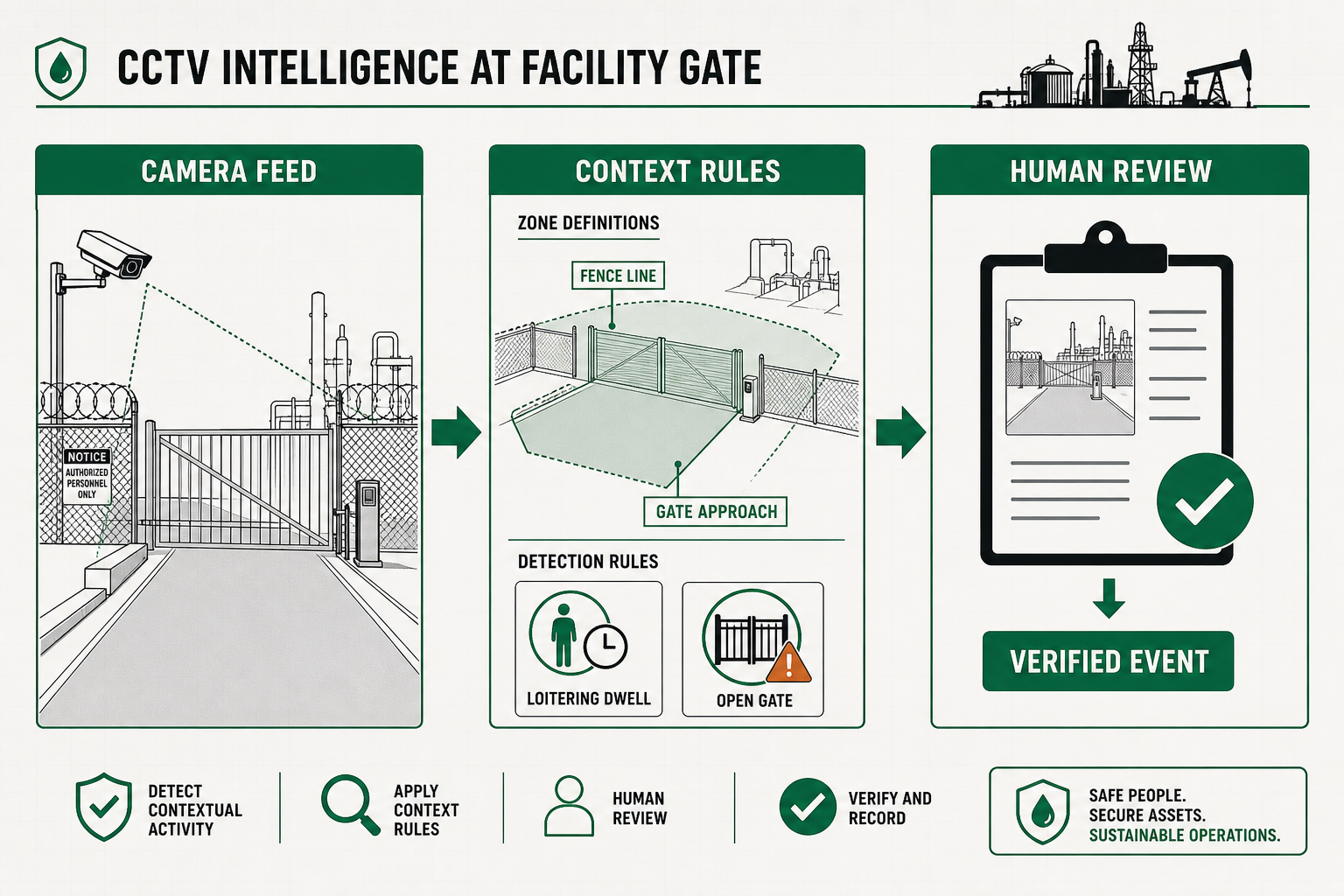
Raw motion detection at a busy Nigerian terminal gate will cry wolf until nobody listens. The difference between noise and signal is context: where the detection happened, how long it lasted, what your site policy says about that zone, and whether a person confirmed it before it reached the wider team.
Zone rules matter. A pedestrian on the approved approach to the gatehouse is normal. The same person lingering twenty minutes at a rarely used side gate at 02:00 is not. A vehicle in the official inbound lane is operations. A vehicle idling against the fence beyond the holding area is a different event. Without those distinctions, analytics teach your crew to ignore the wall.
Human review matters for the same reason it matters in PPE and zone-entry work. Models propose. People accountable for the site decide. The goal is not to automate judgment away, but to stop relying on continuous perfect attention across every feed.
What this is not
It is not a claim that CCTV intelligence alone stops pipeline vandalism along a right of way. Facility cameras do not see that corridor. It is not a claim that analytics replace physical security, access control hardware, or community engagement. And it is not a promise of zero incidents. The honest language is preventable exposure: more of the right events caught earlier, with evidence you can stand behind when Security, HSE, Operations, or a regulator asks what you knew and when.
Where to start
Begin with the cameras that already see the main gate and the highest-risk fence segments. Define a small number of zones and dwell rules with Security and HSE together, so the alert policy matches how the site actually works. Route candidates through a review queue before they become loud escalations. Keep raw video on site by default, with edge inference that still works when the link drops, because many Nigerian facilities cannot treat the cloud as part of the safety or security function.
Then expand to secondary gates, critical yards, and night-only rules. Portfolio value appears when a verified open-gate or loitering event looks the same in Port Harcourt as in a Lagos depot, and the evidence pack does not have to be rebuilt from scratch each time.
What it comes down to
Nigerian oil and gas sites already pay for perimeter and gate CCTV. The gap is rarely "more cameras." The gap is turning those feeds into facility intelligence that Security, HSE, and Operations can share: intrusion, loitering, unauthorized access, and the coverage failures that hide them. Keep the scope honest, stay at the facility boundary, and prefer context and human review over raw pings. Do that consistently, and the cameras you already own start earning their keep on every shift.
MilkenLabs is a CCTV intelligence layer for oil and gas facilities in Nigeria and across Sub-Saharan Africa, covering facility perimeter and gate events alongside HSE and operations detections on the cameras operators already run. Explore capabilities or request a demo.