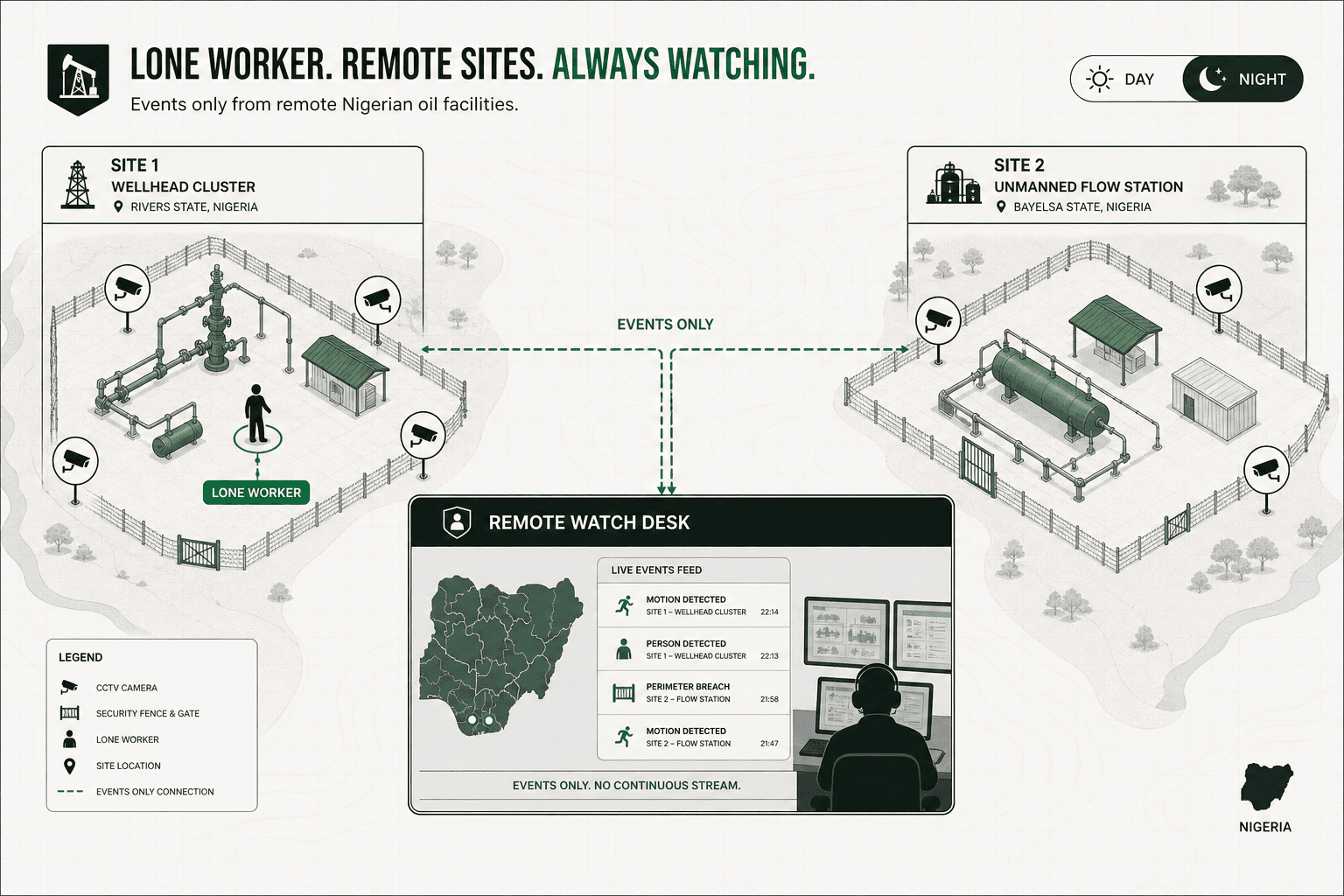
Lone Worker and Remote Facility Watch on Existing CCTV in Nigeria
Many Nigerian oil and gas sites are not full of people. Wellhead clusters, manifolds, small flow stations, and satellite yards may run with a thin crew by day and almost nobody by night. A lone technician on a remote pad, a two-person night team at a depot gate, an unmanned facility checked by occasional patrol: these are ordinary operating patterns. They are also where delay kills. If someone goes down, if a perimeter is breached, or if a camera that was supposed to be watching has been dark for hours, the next person to learn about it should not be the morning shift.
This article is about using the CCTV already installed at those facilities as a remote watch and lone-worker assist, not as a claim that cameras replace radios, man-down devices, or physical response. The goal is earlier awareness for Security and HSE when a remote site stops looking normal.
Why the control-room model breaks
A wall of live feeds works, barely, when one busy terminal fills the screens and a crew is paid to stare. It fails when the portfolio includes ten quiet sites and two busy ones. Quiet sites produce long stretches of nothing, which is exactly when attention drifts. The dangerous moments are rare and short. A person collapses out of frame edge. A figure appears at a fence that is usually empty. A gate camera flips to a washed-out view after rain and stays that way.
Remote facility watch is the practice of treating those quiet sites as first-class: not continuous human staring, but continuous machine attention with human review when something may matter. Lone-worker support is the same idea focused on people who are working without a nearby crew.
What the cameras can actually watch
In oil and gas HSE language, a lone worker is someone performing work without close or direct supervision, often beyond immediate shout or sight of others. On Nigerian remote pads that can mean a technician checking equipment alone, a security post with one person overnight, or a short visit to an unmanned facility.
CCTV cannot know everything about that person's task. It can help with a narrower set of leading indicators when the person is in view of a camera you already have:
Person down or prolonged inactivity in a work zone. A body posture or lack of expected movement that warrants a check-in, not an automatic medical conclusion.
Unexpected presence where the site should be empty. A person at an unmanned facility outside the booked visit window.
Lone worker still on site after expected departure. Dwell beyond the planned visit, especially at night.
None of these replace a dedicated man-down wearable where your policy requires one. They add eyes on the places your cameras already see, which is often the difference between a delayed welfare check and a timely one.
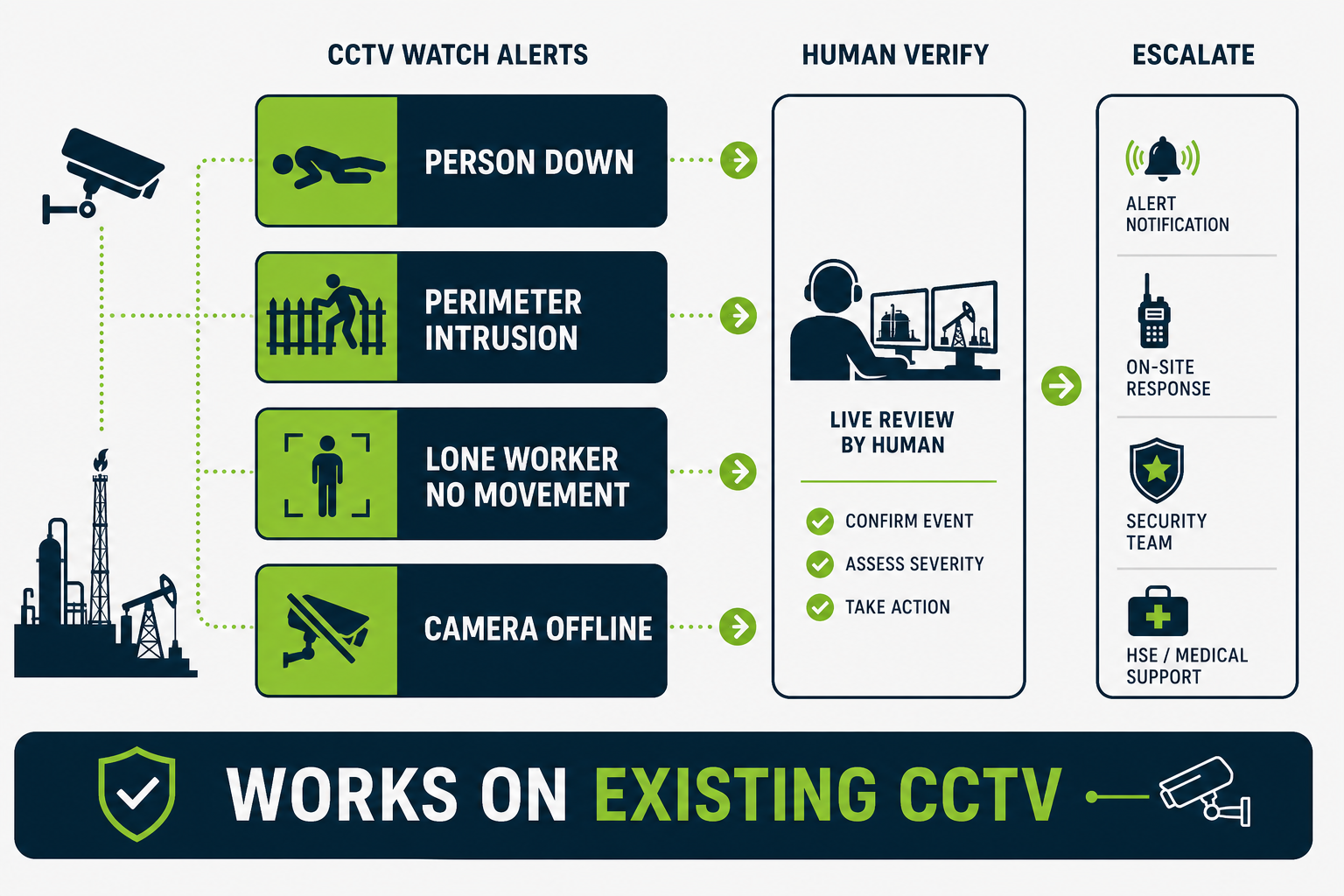
Security naturally thinks about perimeter intrusion and unauthorized access at quiet sites. That belongs in the pack. Equally important, and often neglected, is whether the watch layer itself is intact.
Camera offline or tampered. A remote site with a dark or obscured camera is not "low risk because nothing alerted." It is unknown risk.
Loitering and open gates during unmanned hours. Rules that make sense in daylight at a manned gate need night and unmanned variants.
Fire, smoke, and spill assists where cameras cover process areas. These remain HSE events even when the Security desk sees them first. Remote watch only works if Security and HSE share the same event language instead of arguing about ownership while the clip sits unreviewed.
The point is a single remote-watch practice: the site is either behaving within policy, or a verified exception needs a human decision.
Connectivity and OT reality
Remote sites are exactly where cloud-only analytics fail. Links drop. Power is uneven. OT and security teams will not approve streaming operational video off-site as a condition of safety. The workable pattern is edge inference on an on-site appliance, alerts that still fire locally when the wide-area link is down, and optional sync of events and consented evidence when the link returns. Raw video stays on the operator network by default.
That architecture is not a marketing flourish for remote watch. It is the only design that matches how these sites actually live.
A watch desk people trust
Technology fails socially when every ping is equal. A remote watch desk needs severity, zones, and review.
Start with a short list of event types per site class (manned gate, unmanned pad, night-only depot). Define who receives which alert at which hour. Require human confirmation before loud escalation on ambiguous events. Keep a clear welfare-check procedure for lone-worker alerts so an inactivity ping becomes a radio call or dispatch, not a shrug. Measure false alarms in the first weeks and tighten dwell and zone rules until the desk trusts the queue.
Trust is the product. Without it, remote watch becomes another screen nobody believes.
What this is not
CCTV alone does not keep every lone worker safe. Cameras miss people behind equipment, inside buildings, and outside their field of view, so this is an assist, not a replacement for man-down wearables, radios, or physical response. It is not a promise of zero remote incidents. What it does offer is a more honest watch: more of the right exceptions surfaced earlier, coverage failures treated as events rather than silence, and evidence kept for when Security, HSE, or Operations need to explain what a site looked like overnight. It also stays facility-scoped. Facility cameras do not reach across kilometre-scale pipeline corridors, and remote facility watch does not pretend they do.
What it comes down to
Lone worker risk and unmanned facility risk are ordinary in Nigerian oil and gas operations. The cameras on those sites are often treated as archive until something goes wrong. A better use is continuous, context-aware watch with human review: person-down and inactivity assists, perimeter and gate exceptions, and camera-health events that tell you when you are blind. Keep the scope facility-focused, keep inference on-site, and keep people accountable for escalation. That is how existing CCTV becomes a remote watch layer crews can rely on between visits, not only a recording to rewind after harm.
MilkenLabs supports remote facility watch and lone-worker assists as part of facility CCTV intelligence for oil and gas sites, running on existing cameras with edge-first deployment suited to remote Nigerian operations. Explore capabilities or request a demo.