Beyond NOSDRA: How Nigeria's Oil and Gas Safety Regulators Fit Together
If your picture of Nigerian oil and gas compliance begins and ends with NOSDRA, you are looking at one gauge on a much bigger dashboard. NOSDRA leads on spills, but an operator's health, safety and environment duties run through several regulators whose boundaries were redrawn only a few years ago and are still being settled in court and by government directive. This guide lays out the full map so an HSE or operations leader can see where each obligation actually sits, and why keeping good records across all of them is easier than it sounds.
It is written for people who need the shape of the landscape, not a section-by-section legal reading.
One regulator became two
For decades the Department of Petroleum Resources, or DPR, was the single regulator for the whole industry. The Petroleum Industry Act of 2021, usually shortened to the PIA, dissolved that arrangement and split it along the value chain into two bodies.
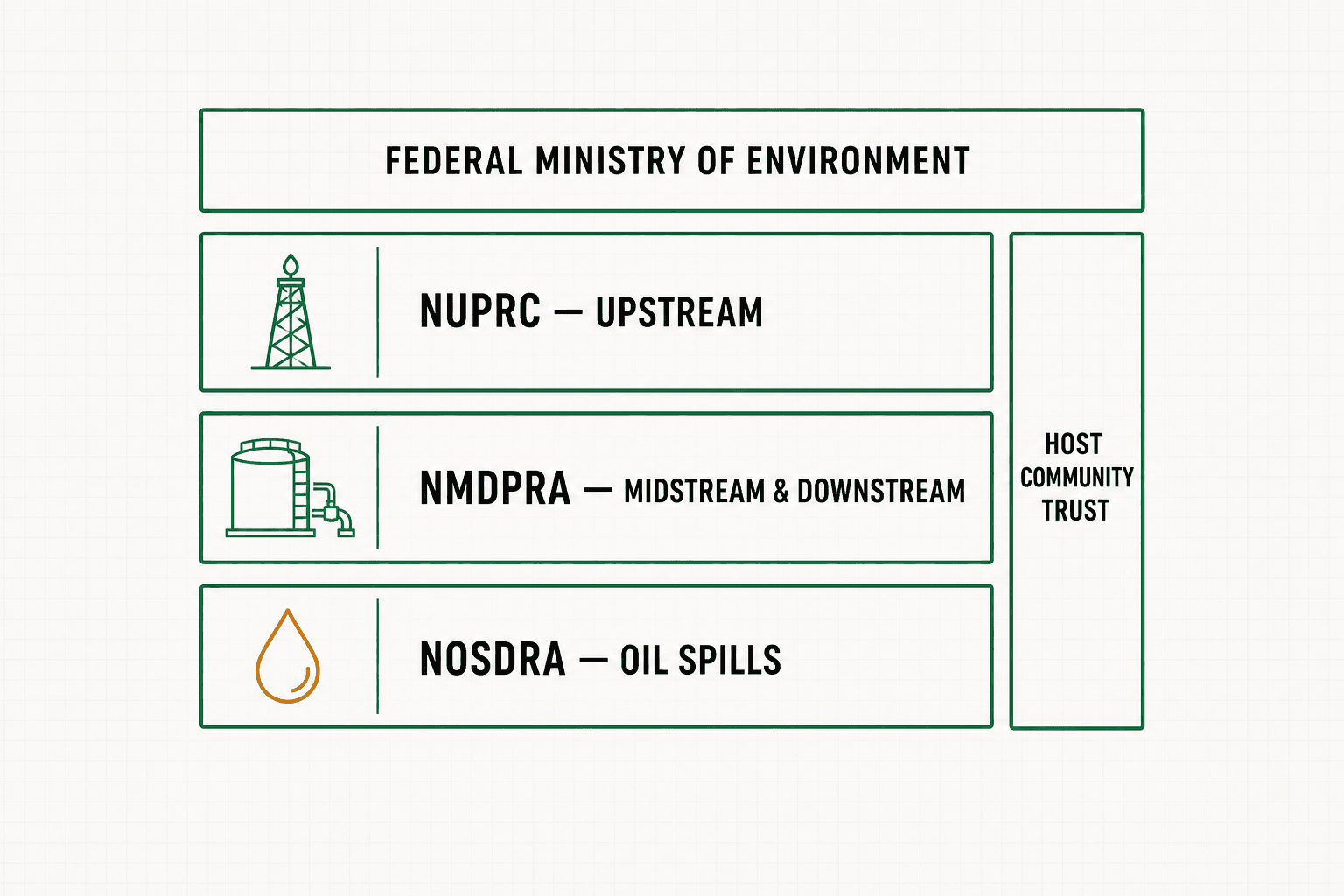
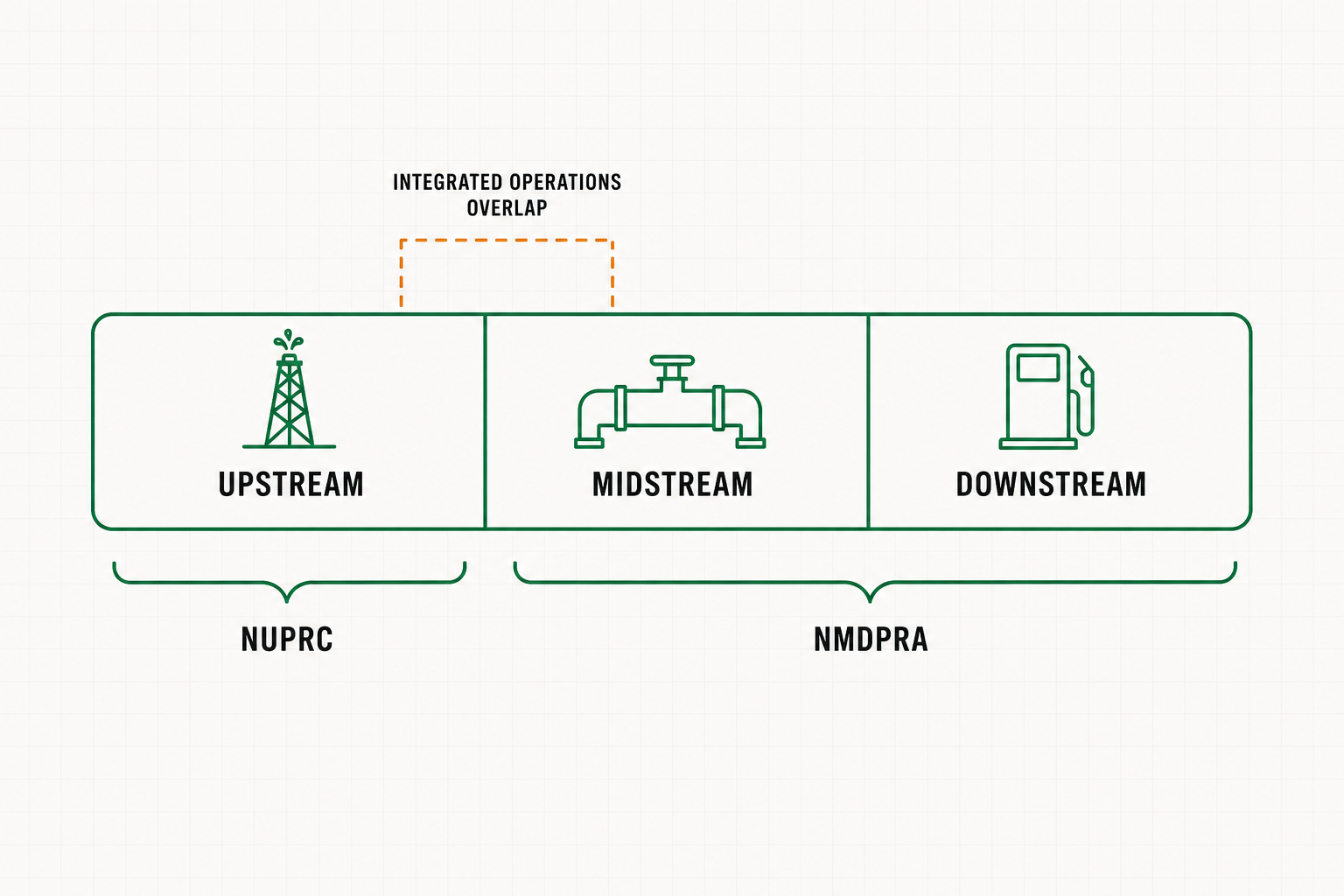
The first is NUPRC, the Nigerian Upstream Petroleum Regulatory Commission. It regulates the upstream: exploration, development and production. It took over most of the old DPR's upstream technical and safety work. The second is NMDPRA, the Nigerian Midstream and Downstream Petroleum Regulatory Authority. It regulates the midstream and downstream: processing, storage, transport, refining, distribution and marketing.
For an HSE leader, the practical point is simple. Where your facility sits on the value chain decides who your main petroleum regulator is. An upstream flow station answers to NUPRC on the safety of its operations. A midstream storage terminal or pipeline answers to NMDPRA. Both regulators are required to make operators keep risk as low as reasonably practicable, a principle carried over from the old regime and often written as ALARP.
Where the lines still blur
The split is tidy on paper and messier in practice, and any operator of integrated facilities should know why. The friction sits around what the law calls integrated operations, where upstream production connects straight into midstream processing or an export terminal. The PIA hands oversight of these integrated facilities to the upstream regulator, but at the same time gives the midstream authority real powers over storage, transport and export logistics. That overlap has caused genuine disputes, including litigation over export-terminal operations and a June 2023 presidential directive that placed integrated operations under NUPRC up to the crude export terminal, with NMDPRA taking over from the exit point onward. A 2025 amendment bill has since been introduced to try to fix these boundaries in law.
You do not need to follow the court cases. You do need to recognise that if you run integrated facilities you may face two regulators touching the same site, which means your records and reporting have to be portable enough to satisfy either one without being rebuilt from scratch.
The safety permit history
The old DPR ran a set of well-known safety programmes, the Offshore Safety Permit being the most familiar, and those permitting functions carried into the new upstream regime. For offshore and upstream operators, permit-linked safety duties are still a live and auditable requirement. The regulator inspects against them, which means you need to be able to show safe operation on demand, not simply state that it is happening.
Where NOSDRA and host communities fit
NOSDRA does not disappear in this structure. It sits alongside the petroleum regulators, under the Federal Ministry of Environment, as the lead agency specifically for oil spill detection and response. So a single upstream operator can answer to NUPRC on operational and facility safety, to NOSDRA on any spill, and to the Ministry of Environment on wider environmental matters, all at once. These are concurrent duties, not a menu you choose from.
The PIA added an obligation that sits a little outside the usual safety frame but connects to it directly. Every operating company has to set up a Host Community Development Trust and put a share of its yearly operating spend into it. Reporting has flagged that a good number of operators are not fully compliant. Safety and environmental performance are tied to the community relationship, because a spill or incident that harms a host community is not only a NOSDRA matter, it is a trust and licence matter. Operators can no longer treat community relations and safety as separate files.
What this means for your records
Step back from the individual agencies and one need becomes clear. An operator wants a single defensible account of what happened at a facility that can be shown to whichever regulator asks, whether that is NUPRC in an upstream safety audit, NOSDRA at a spill investigation, NMDPRA for a midstream facility, or the Ministry of Environment for an environmental review.
The trap is keeping separate, inconsistent records for each regulator and assembling them reactively whenever one asks. That is slow, expensive and risky, because gaps between what you told one regulator and another are exactly what damage your credibility in an audit.
This is the real argument for continuous, verified record keeping. When the cameras already watching your facilities produce timestamped, human-checked events written to a record that cannot be quietly altered, you stop maintaining several reactive files and start maintaining one trustworthy account. A verified PPE, spill or proximity event carries the same weight whether it feeds a NUPRC safety demonstration or a NOSDRA spill report.
The map, in one line
Nigerian HSE compliance is not one regulator, it is a map: NUPRC upstream, NMDPRA midstream and downstream, NOSDRA on spills, the Ministry of Environment above, and host community duties running through all of it, with some boundaries still being settled. An operator who understands the map stops treating each audit as a fresh fire drill and starts treating compliance as one continuously maintained account of the truth. That shift, from reactive reconstruction to a standing evidence base, is what makes a multi-regulator environment manageable rather than merely survivable.
MilkenLabs turns existing CCTV into verified, audit-ready HSE records built for the regulators Nigerian operators actually answer to, across upstream and midstream. Explore capabilities or request a demo.
This article is general information, not legal advice. Confirm current obligations under the PIA 2021 and its regulators with qualified Nigerian counsel.