NOSDRA Spill Reporting: What Nigerian Oil & Gas Operators Must File, and When
If you operate a pipeline, flow station, terminal or well in Nigeria, the National Oil Spill Detection and Response Agency (NOSDRA) is the regulator that will decide whether your response to a spill was adequate, and the record you produce in the hours and days after an incident is what that judgment rests on. This guide walks through what NOSDRA expects, in what order, and where operators most often lose time and defensibility.
It is written for HSE managers, environmental compliance leads, and operations teams who already know their sites and want a clear picture of the reporting chain, not a legal treatise.
Who NOSDRA is, briefly
NOSDRA was established by Act No. 15 of 2006, sitting under the Federal Ministry of Environment, to coordinate Nigeria's National Oil Spill Contingency Plan. The agency is the lead body on every oil spill matter in the country: it convenes investigations, monitors clean-up, and mediates between operators and host communities. It is one of several regulators an operator answers to, alongside the Nigerian Upstream Petroleum Regulatory Commission (NUPRC), the Nigerian Midstream and Downstream Petroleum Regulatory Authority (NMDPRA), and the Federal Ministry of Environment, but on spills specifically, NOSDRA leads.
One structural fact shapes everything else: NOSDRA's spill data is gathered largely through the cooperation of operators themselves, via site investigations and company-supplied estimates. In practice, that means the quality of your own record directly shapes the official record.
The reporting chain, step by step
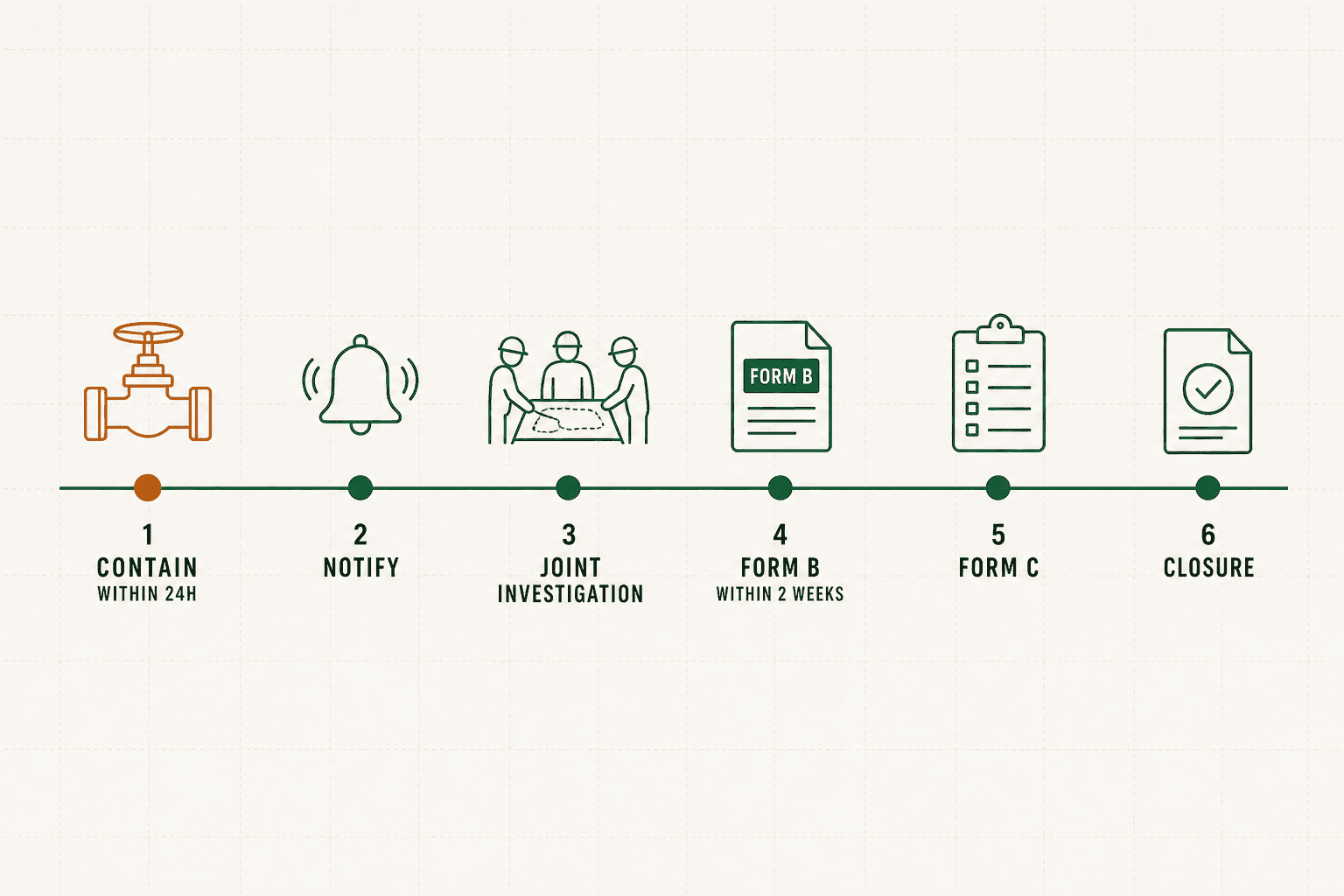
1. Contain within 24 hours
Once an operator is notified of a spill in its jurisdiction, the spill must be stopped or closed off within 24 hours. This is the first obligation and the first thing an investigation will look at. Everything downstream (the community relationship, the liability question, the regulator's posture) is influenced by whether containment happened inside that window.
2. Notify the regulator immediately
Notification is the most time-critical administrative step. NOSDRA runs an alerts email and emergency lines, and the clock on regulatory obligations effectively starts at notification. A spill discovered but not promptly notified is a far worse position than the spill itself often warrants, because the failure is procedural and entirely within the operator's control.
3. The Joint Investigation Visit (JIV)
The JIV is the heart of the Nigerian process and the step with no real analogue in Western regimes. After a report, NOSDRA convenes a Joint Investigation Visit to the site. The participants typically include representatives of the operator whose facility was affected (often the HSE manager and a legal representative), representatives of the affected host community, and NOSDRA as lead agency, sometimes alongside other government representatives.
The JIV is where the two facts that determine liability get established on the record: what happened and what caused it. A recent, concrete example: in February 2025, NOSDRA received a report of a crude oil spill on a Shell (SPDC) pipeline at Obololi community in Southern Ijaw LGA, Bayelsa State, convened a JIV within days, and published a running update on containment and recovery timelines. That is the process working as designed: report, investigate jointly, document, monitor recovery.
4. Cause and the liability split
Nigerian spill law turns sharply on cause, because cause decides who pays. Operator-caused spills (equipment failure, corrosion, maintenance neglect, operational error) carry full operator liability for clean-up, restoration, and community compensation. Third-party-caused spills (sabotage, vandalism, illegal bunkering) produce contested liability. The JIV is the mechanism that classifies each spill into one of these buckets, which is precisely why the evidence captured at that visit matters so much. Note too that responsibility for clean-up itself attaches to the operator whose facility was compromised regardless of cause.
5. File Form B
Within two weeks of a spill being identified, the operator must submit Form B, a report enshrined in Nigerian law that sets out the areas of impact, the area the spill covered, quantities spilled and recovered, the cause, and the containment and clean-up measures taken.
6. File Form C at clean-up completion
When clean-up is deemed complete, the operator submits Form C, reporting on the clean-up operation. NOSDRA reviews Form C and, when satisfied, issues a closure notification. Form C is what initiates regulatory closure: until it is filed and accepted, the incident remains open.
A note on penalties
Operators should be aware that the penalty picture in Nigeria is genuinely contested in public sources, and it is worth confirming the current position with counsel rather than relying on any single figure. Some regulatory commentary describes a penalty of ₦500,000 per day for failure to report; other longstanding descriptions of the regime note the historic absence of binding fines for the spills themselves, with the enduring obligation being that the operator funds clean-up and compensates affected communities where at fault. Reform efforts to strengthen and raise penalties have been debated for years. The safe operating assumption is simple: reporting failures are the exposure you can most easily avoid, and clean-up liability is the exposure that dwarfs any filing fine.
Where operators actually lose
Almost none of the pain in this process comes from the rules being unclear. It comes from reconstruction: trying to assemble, after the fact, a defensible account of what happened, when, and what was done about it, often from fragmented CCTV, paper logs, and people's memories. When a JIV convenes and a community representative and a regulator are both at the table, "we think it started around then" is a weak position. A timestamped, evidence-linked account is a strong one.
Three failure modes recur:
- The notification gap. The spill is known internally hours before it is formally notified, and that gap becomes the finding.
- The evidence gap. Containment happened, but there is no clean, attributable record proving when, so the 24-hour question stays open.
- The reconstruction tax. Form B is due in two weeks, and the team spends most of that window rebuilding a timeline instead of managing the response.
Where continuous monitoring helps
This is where a real-time HSE intelligence layer earns its place. If the cameras already watching your facilities are continuously detecting the early signatures of a leak or spill, three things change:
- Detection and notification move closer together. A spill or leak flagged the moment it appears, and routed to a reviewer, shortens the distance between "it happened" and "we reported it". That is the gap that regulators penalise.
- The record builds itself. Every verified event carries its own timestamp, location, and linked visual evidence, written to an append-only audit trail. When the JIV convenes, the account already exists.
- Form B stops being a reconstruction exercise. Verified events can pre-fill the incident and spill records the regulator requires, with evidence attached, so the two-week window is spent responding rather than remembering.
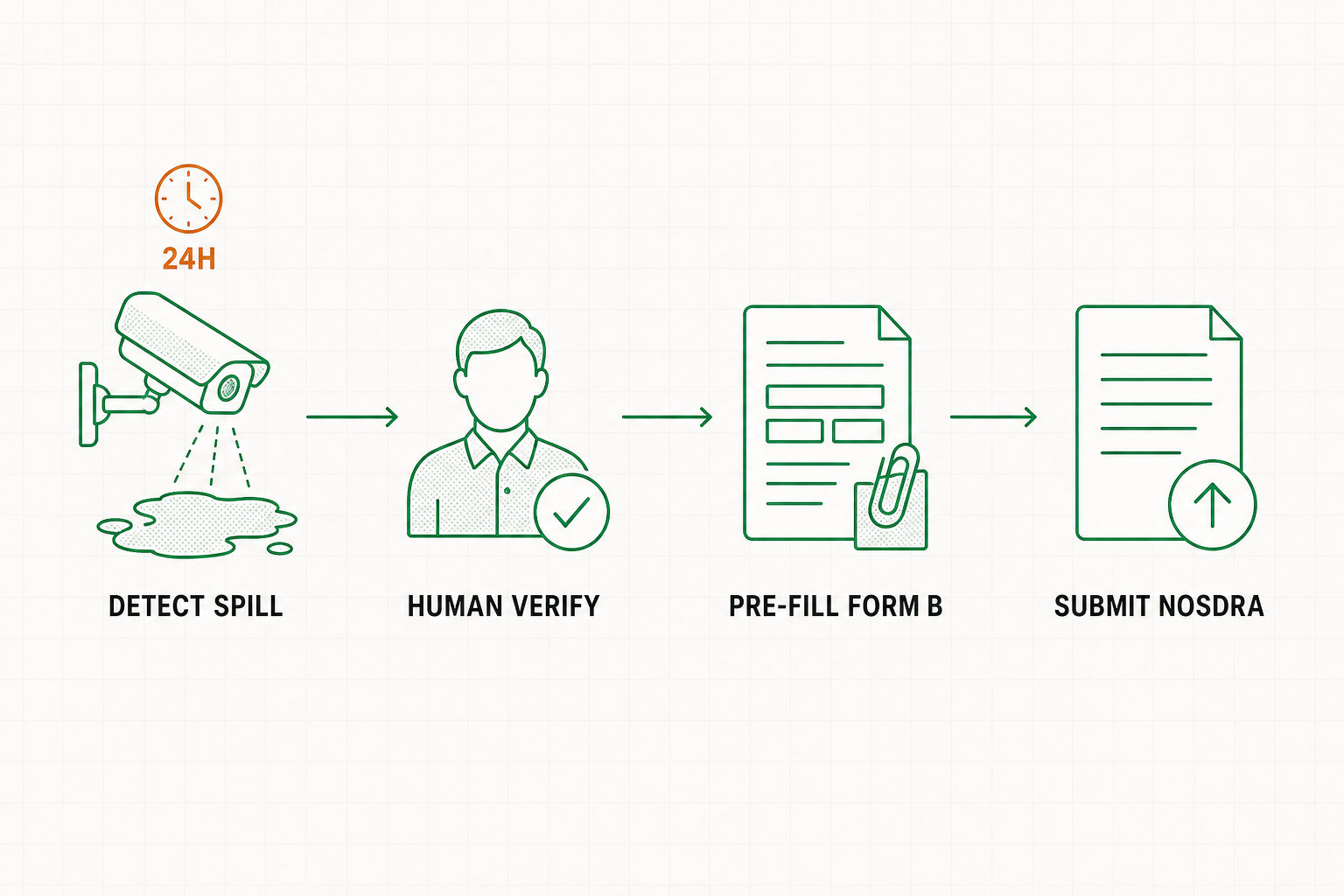
MilkenLabs is built for exactly this: an intelligence layer on the CCTV Nigerian operators already run, tuned for the leading indicators that precede harm, with compliance records, including NOSDRA spill records, produced natively rather than bolted on afterward. Human reviewers stay at the centre; nothing auto-submits. The goal is not to replace the operator's judgment in front of NOSDRA, but to make sure that judgment is backed by a record that holds up at the JIV table.
What it comes down to
NOSDRA's process is demanding on timing: 24 hours to contain, prompt notification, a joint investigation that fixes cause and liability, Form B in two weeks, Form C to close. None of those steps is hard to understand. What makes them hard to meet is the state of your evidence when the clock is running. Operators who treat the record as something they generate continuously, rather than reconstruct under pressure, spend the response window responding, and arrive at the JIV, the insurer conversation, and the audit with an account they can defend.
MilkenLabs builds the intelligence layer for oil and gas operations in Sub-Saharan Africa, turning existing CCTV into real-time safety awareness and audit-ready compliance records. Request a demo to see it run against the cameras you already operate.
This article is general information, not legal advice. Confirm current NOSDRA obligations and penalties with qualified Nigerian counsel.