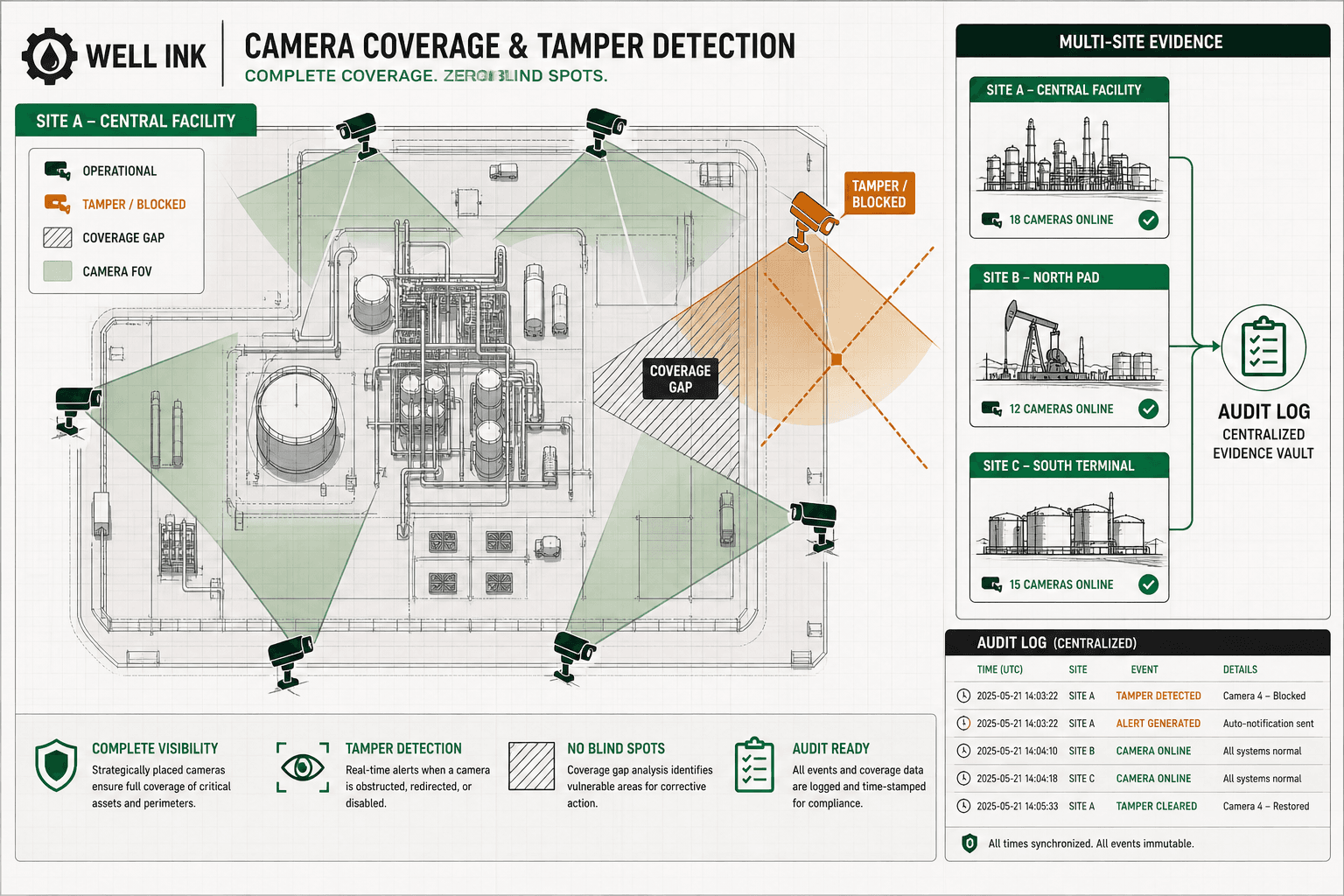
Camera Coverage Gaps, Tamper, and Multi-Site Evidence for Security, HSE, and Ops
Every serious conversation about CCTV intelligence eventually reaches an uncomfortable point. The detections, the zones, the review queue, the compliance record: all of it assumes the camera can see. On real Nigerian facilities, that assumption fails often enough to matter. Lenses fog. Housings get knocked. Someone "temporarily" points a camera at a new job and never points it back. A switch port dies. A recorder fills. The control room still shows a grid of rectangles, so the organisation believes it is covered.
This article is about treating camera health, coverage gaps, and multi-site evidence as part of the intelligence layer itself, not as a side chore for the IT vendor. Security, HSE, and Operations all depend on the same truth: when something happened, could we see it, and can we prove what we saw?
Coverage is a safety and security control
If your PPE rule, perimeter rule, or loading-bay rule depends on a camera, then a blind camera is a failed control. It is not a maintenance ticket with low priority. It is closer to a missing barrier on a live job.
That framing changes behaviour. A tamper or coverage-gap event should enter the same review discipline as a loitering or zone-entry event: severity, owner, time to restore, and a record that the gap existed. Otherwise audits and investigations discover the blindness only when it is too late to be useful, which is when regulators, insurers, and host communities ask what continuous monitoring actually meant.
The gaps worth detecting
You do not need a poetic taxonomy. You need a practical one.
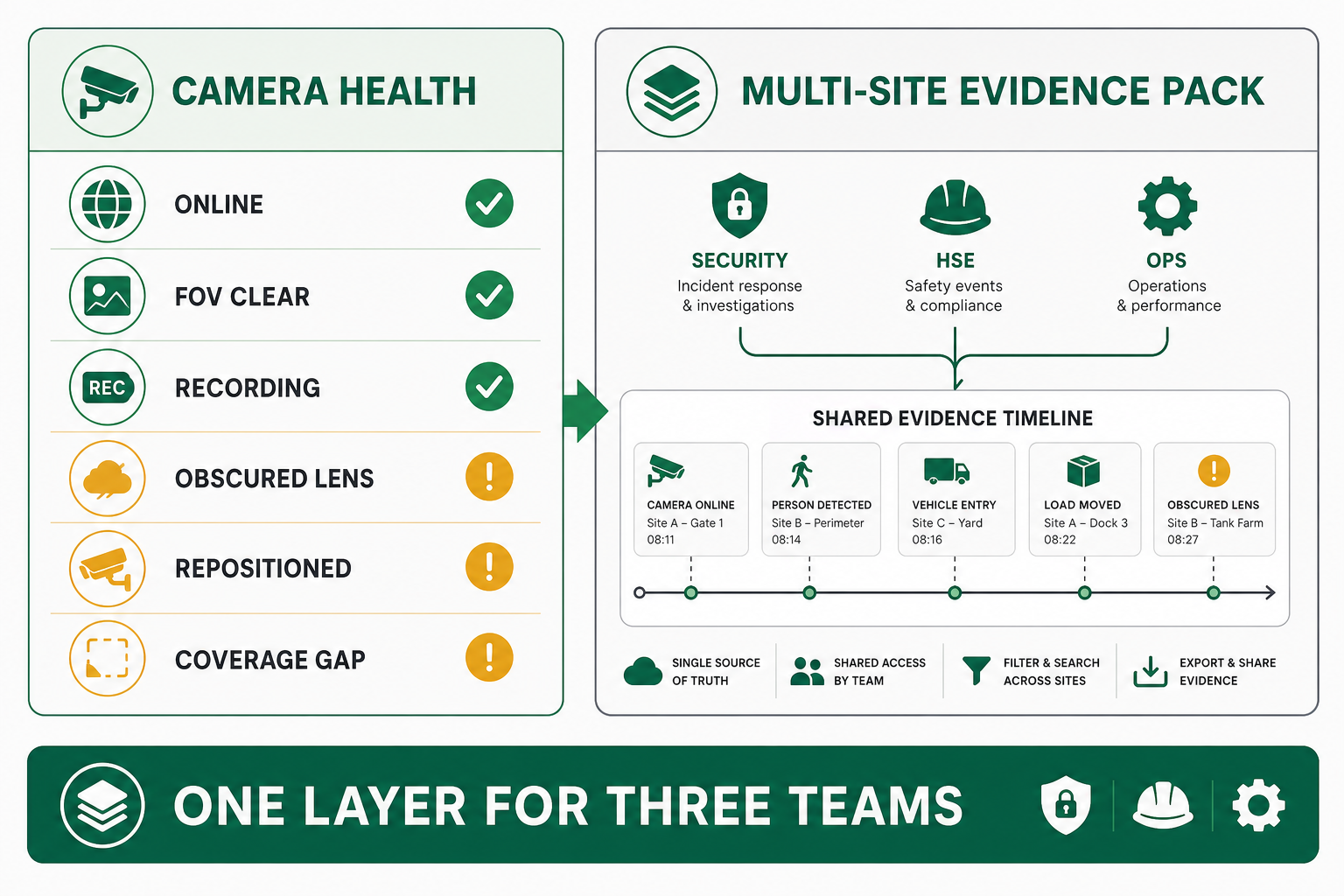
Camera offline. No signal, no stream, no heartbeats from the edge path you expect.
Obscured or washed-out view. Fogged dome, covered lens, extreme glare, or a view that no longer contains the scene the zone was drawn for.
Repositioned field of view. The scene changed enough that your perimeter polygon or bay zone no longer maps to reality.
Persistent coverage gap between cameras. Especially at fence corners, rear yards, and secondary gates where people already know the blind spot.
Recording or evidence-path failure. The live view may work while the path that preserves a clip for review does not. That failure is an evidence event, not an inconvenience.
These are leading indicators for Security (someone may have created the blind spot) and for HSE and Operations (your monitoring claim is currently false).
Multi-site evidence is the portfolio problem
A single terminal can sometimes compensate with tribal knowledge. A portfolio cannot. Nigerian operators with assets across onshore and midstream sites need the same event language in every gatehouse and control room: what happened, where, when, who verified it, and what clip supports it.
Multi-site evidence means more than a central video wall. It means:
One event object across sites. A verified perimeter intrusion in Delta and a verified blocked egress in Lagos should be comparable without a translation layer of local spreadsheet habits.
Role-appropriate views. Security, HSE, and Operations may escalate differently, but they should not maintain three incompatible archives of the same minute.
Audit trails that survive staff turnover. The record has to explain itself months later when the shift lead has moved and a regulator or internal investigation asks for the pack.
Edge-first capture with controlled sync. Remote sites will not always be online. Evidence must be born on site and travel as events and consented clips when policy and connectivity allow, not as a permanent raw-video pipeline to someone else's cloud.
Splitting tools by department recreates the blindness problem in software form. Security buys a tamper tool. HSE buys a PPE tool. Operations buys a yard tool. After an incident, nobody can assemble one timeline without manual stitching. The facility does not experience the incident as three departments. The facility experiences one sequence: a camera was dark, a gate stayed open, a truck entered, a pedestrian crossed, a near-miss occurred. Your evidence system should be able to tell that story in order.
A shared CCTV intelligence layer, with packs for Security, HSE, and Operations on the same cameras, is how you avoid paying three times to disagree later.
How to test a vendor on coverage
In demos, ask to see failure, not only detection success. What happens when the lens is covered? When the camera is rotated away from the zone? When the site link drops mid-shift? Where do raw clips live? Who can export an evidence pack for one event across Security and HSE fields? Can a regional manager see open coverage gaps across all facilities without calling each site?
Be wary of accuracy theatre that never mentions blindness. A system that never admits it cannot see will eventually teach your crews not to trust it when it claims it can.
A practical rhythm
Make camera health part of shift handover, not only a monthly maintenance round. Give coverage-gap events an owner and a repair clock. Review repeat tampers as Security patterns, not as bad luck. For multi-site fleets, publish a simple coverage status alongside incident status so leadership sees monitoring debt the same way they see overdue actions. None of this requires claiming perfect surveillance. It requires refusing to pretend.
What it rests on
CCTV intelligence for Nigerian oil and gas facilities is only as strong as the cameras' ability to see, and as the organisation's ability to keep one evidence story across Security, HSE, and Operations. Treat tamper and coverage gaps as first-class events. Keep raw video local by default. Sync verified evidence in a form a portfolio can use. Do that, and the rest of your detections (perimeter, ANPR, lone worker, loading-bay, PPE, spills) rest on something honest: not the hope that someone was watching, but a defensible account of what was visible, what was not, and what people did next.
MilkenLabs treats camera tamper, coverage awareness, and multi-site evidence as part of the same facility CCTV intelligence layer used for Security, HSE, and Operations across oil and gas sites. Explore capabilities or request a demo.