HSE Intelligence Across Sub-Saharan Africa: Nigeria, Ghana and Angola Compared
An operator with assets in more than one Sub-Saharan African country learns quickly that African oil and gas compliance is not a single thing. The regulators differ, the maturity of the frameworks differs, and the specific reports each one wants differ. What does not change is the underlying job, which is to prove, continuously and defensibly, that your operation is safe, to whichever national regulator happens to be asking. This guide compares three of the region's most important upstream jurisdictions (Nigeria and Ghana in West Africa, and Angola further south in Central Africa on the Atlantic coast) and draws out what a portable approach to safety and compliance has to handle.
It is written for regional leaders working out how to run safety consistently across borders without rebuilding everything in each country.
Nigeria: mature, multi-regulator, spill-focused
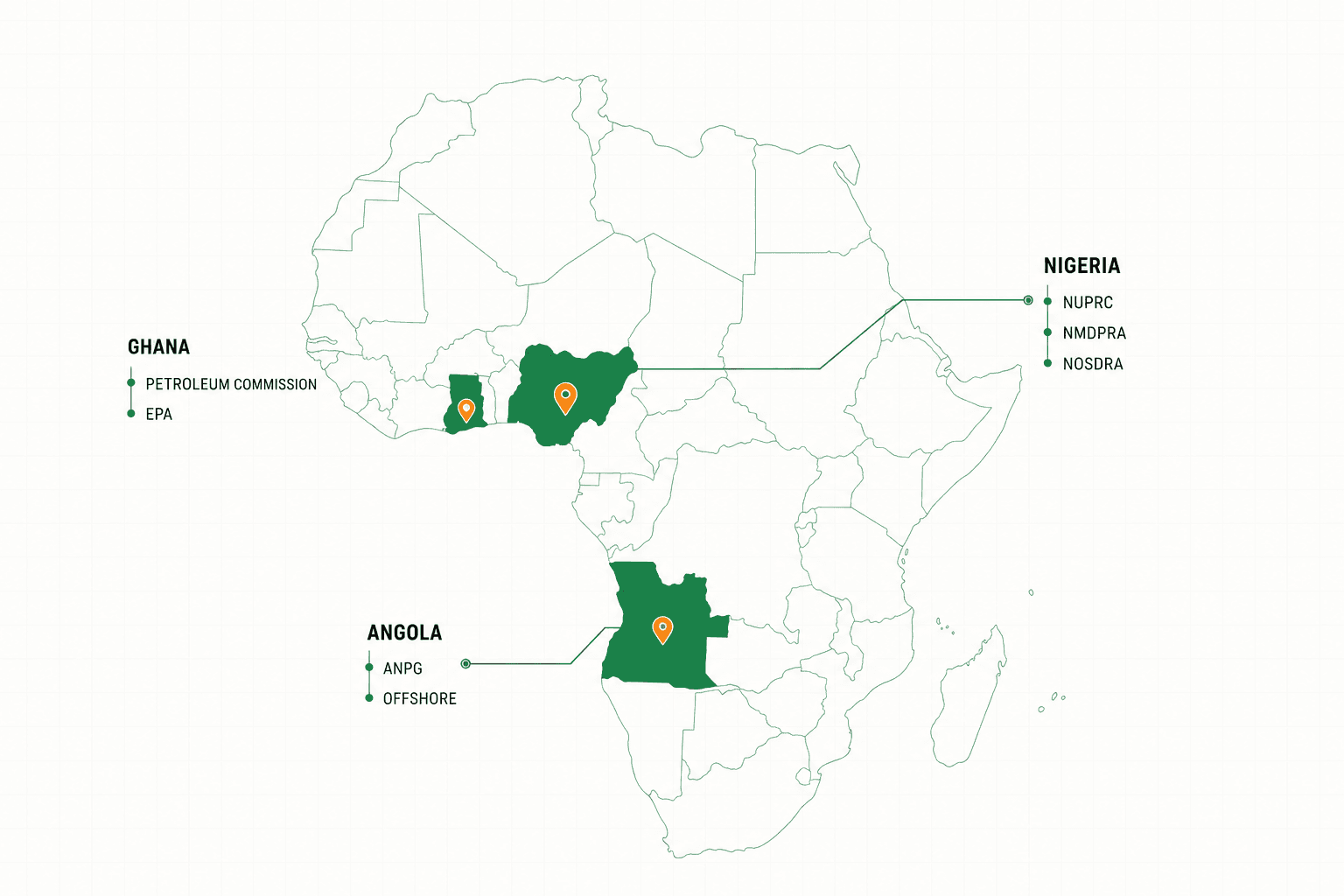
Nigeria has the region's most developed and most complex framework. After the Petroleum Industry Act of 2021, upstream operations answer to the Nigerian Upstream Petroleum Regulatory Commission, or NUPRC, and midstream and downstream operations answer to the Nigerian Midstream and Downstream Petroleum Regulatory Authority, or NMDPRA. The two bodies replaced the former Department of Petroleum Resources. On spills specifically, the National Oil Spill Detection and Response Agency, NOSDRA, takes the lead, with its distinctive Joint Investigation Visit process and its Form B and Form C reporting chain. On top of all that sits a host-community duty that requires operators to fund development trusts.
For a multi-country operator, Nigeria sets the high mark for complexity. Several concurrent regulators, a spill regime with no real equivalent elsewhere, and boundaries between regulators that are still being clarified. The upside is simple. If your safety and evidence approach can satisfy Nigeria, it can generally cope with the rest of the region.
Ghana: consolidated, upstream-clear, EPA-anchored
Ghana's framework is younger, since its commercial oil era effectively began with the Jubilee field in 2007, and it is more consolidated. The Petroleum Commission, established under Act 821 of 2011, is the upstream regulator that promotes, regulates and manages upstream operations, while the National Petroleum Authority handles the downstream. On HSE specifically, the Petroleum Exploration and Production Health, Safety and Environment Regulations of 2017 set out minimum HSE standards and a duty of continuous improvement, and the Environmental Protection Agency enforces environmental standards and permitting.
For operators, Ghana is more straightforward than Nigeria. There is a clearer upstream regulator in the Petroleum Commission, a defined HSE regulation to comply against, and the EPA as the environmental authority. The duty to show safe operation and sound environmental management is just as real. The map is simply less crowded.
Angola: a concessionaire-regulator, heavily offshore
Angola runs a different model again. The National Oil, Gas and Biofuels Agency, known as the ANPG and established in 2019, acts as both the national concessionaire and the sector regulator, supervising and promoting oil and gas activity. Angola's production is heavily offshore and deepwater, and dominated by large international operators, which pushes the HSE profile toward offshore-specific risk. The structure is more centralised in that single agency than either Nigeria's multi-body split or Ghana's commission-plus-EPA arrangement.
For a regional operator, Angola means engaging one powerful agency and an offshore-weighted risk picture. That is a different shape of problem from Nigeria's onshore Niger Delta spill exposure, but it rests on the same basic need to prove safe operation on demand.
What they share underneath
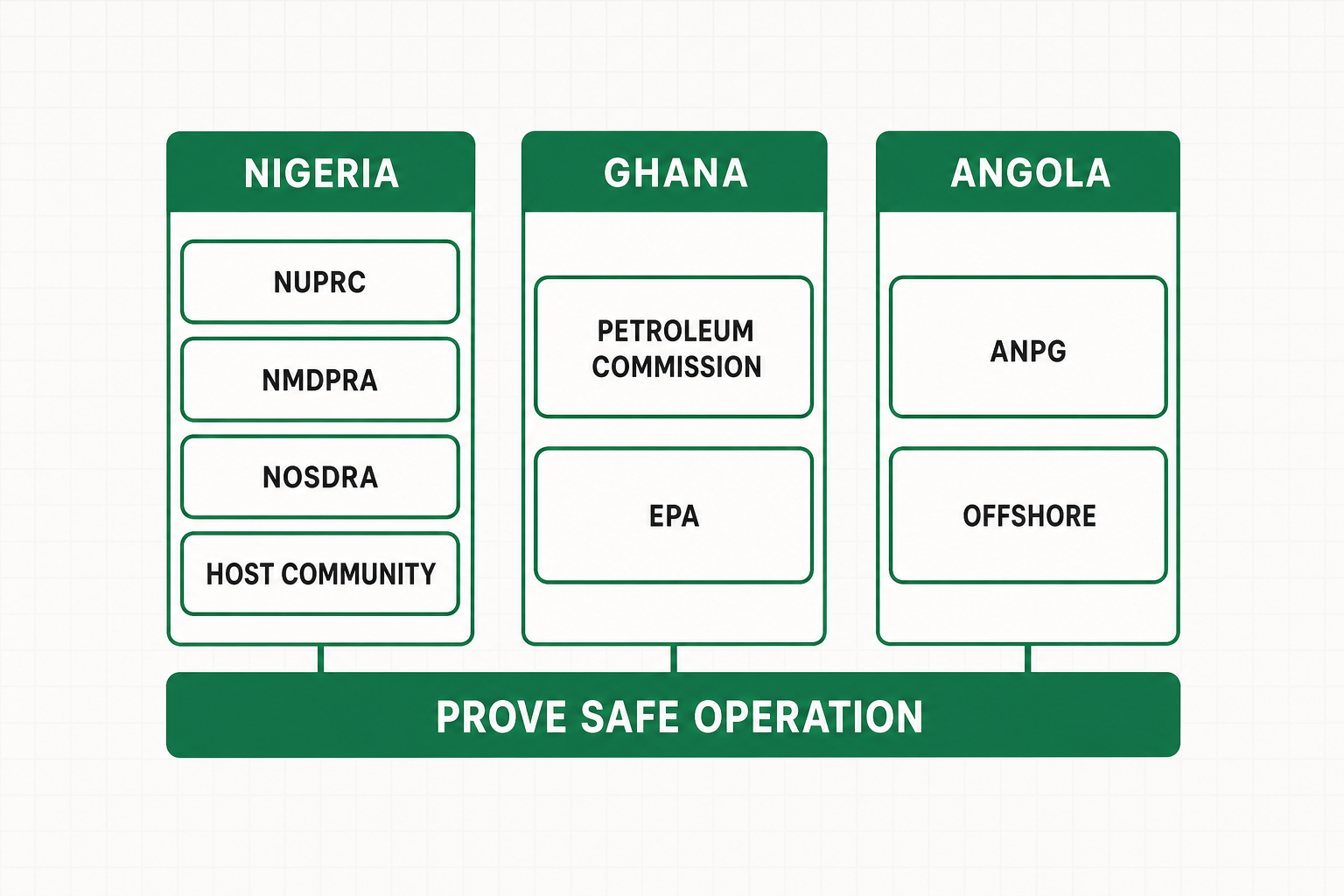
Strip away the acronyms and three things hold true across all three countries.
The operator has to demonstrate safe operation, not merely assert it. Every regime expects evidence that PPE, permit and zone controls were followed, that incidents were handled properly, and that the environment was protected. Assertion is not compliance anywhere.
Incidents trigger a reporting and investigation duty. The specific form differs, from Nigeria's investigation visit and forms to Ghana's HSE regulations and EPA processes to Angola's ANPG oversight, but every regime wants a defensible account of what happened when something goes wrong.
Environmental protection is inseparable from safety. Each jurisdiction ties operational safety to environmental outcomes, and in Nigeria's case to community outcomes as well. A safety failure is rarely only a safety failure.
What a portable approach needs
If the shared need is a defensible, evidence-linked account of safe operation that can be mapped to whichever regulator asks, then the worst option is a different and inconsistent system in each country. That path multiplies cost, scatters your evidence, and makes group-level oversight almost impossible.
The portable alternative is a single way of generating verified safety evidence, using the same continuous detection, human verification and tamper-resistant record everywhere, with a flexible layer that renders that evidence into each country's required format. The evidence base stays uniform. The output adapts. A verified spill, proximity or PPE event is captured the same way in Lagos, Takoradi or Luanda, and all that changes is which regulatory template it feeds.
This also gives regional leadership something no country-by-country setup can. A consistent, comparable view of safety performance across the whole portfolio, because every facility in every country is measured and recorded the same way.
Two design choices make this work across the region whatever the jurisdiction. It has to run on existing infrastructure, because rip-and-replace does not scale across a multi-country portfolio. And it has to run edge-first and be able to work air-gapped, because connectivity and OT-security realities vary widely between a Niger Delta flow station and a deepwater Angolan platform.
The pattern that holds
Nigeria, Ghana and Angola present three different regulatory shapes. Nigeria's complex, multi-regulator, spill-focused regime. Ghana's consolidated upstream commission with an EPA alongside it. Angola's single concessionaire-regulator with an offshore weighting. Beneath them all sits one shared demand, which is to prove safe operation continuously and defensibly to the regulator in front of you. The operator who meets that demand with one portable evidence approach, uniform in how it captures and specific in how it reports, turns a fragmented multi-country burden into a single consistent system, and gains a portfolio-wide view of safety that country-by-country tools can never provide.
MilkenLabs is built for Sub-Saharan Africa, with one approach to verified HSE evidence on existing cameras, edge-first and able to run air-gapped, mappable to the regulators you answer to across the region. Explore capabilities or request a demo.
This article is general information, not legal advice. Confirm current obligations in each jurisdiction with qualified local counsel.