Cutting PPE False Alarms: Why Context Beats Raw Detection in Safety AI
There is a specific way that safety AI dies in a real facility. It is not a dramatic failure. The system gets installed, it works in the demo, and then within a few weeks the alerts start scrolling past unread. A month in, the control room has quietly learned that most of the pings are wrong, and they treat all of them as noise. The technology still runs. Nobody acts on it. That is the failure.
The cause is almost always the same: false alarms. And the fix is almost never "a more accurate model." It is context.
Accuracy was never the problem
Vendors love to quote detection accuracy. Modern object-detection architectures reach very high mean average precision on common PPE items (hard hats, vests, gloves) and get better still when tuned on a specific site's footage. Those numbers are real. They are also not where field deployments fail.
A model that is 97% accurate at detecting whether a person is wearing a hard hat will still flood your team with useless alerts, because detecting a bare head is not the same as detecting a violation. A worker with no hard hat standing in a canteen, an office, or a designated safe walkway is not a safety event. A model with perfect PPE-detection accuracy that fires on all of them is worse than useless. It is actively training your crew to ignore it.
The gap between "accurate detection" and "useful alert" is the whole game. And you close it with context the model alone does not have.
The context that kills false alarms
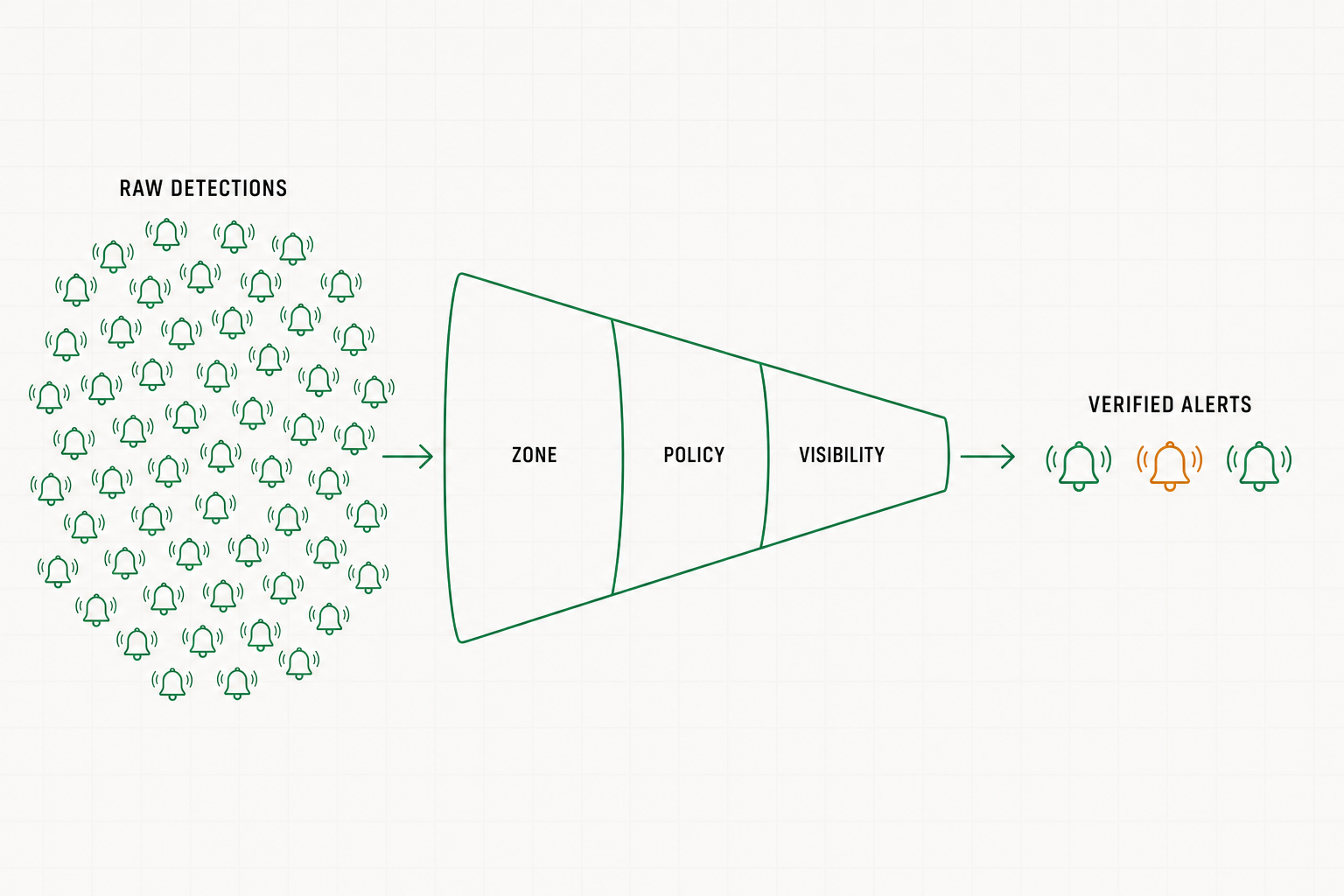
1. Where: zone awareness
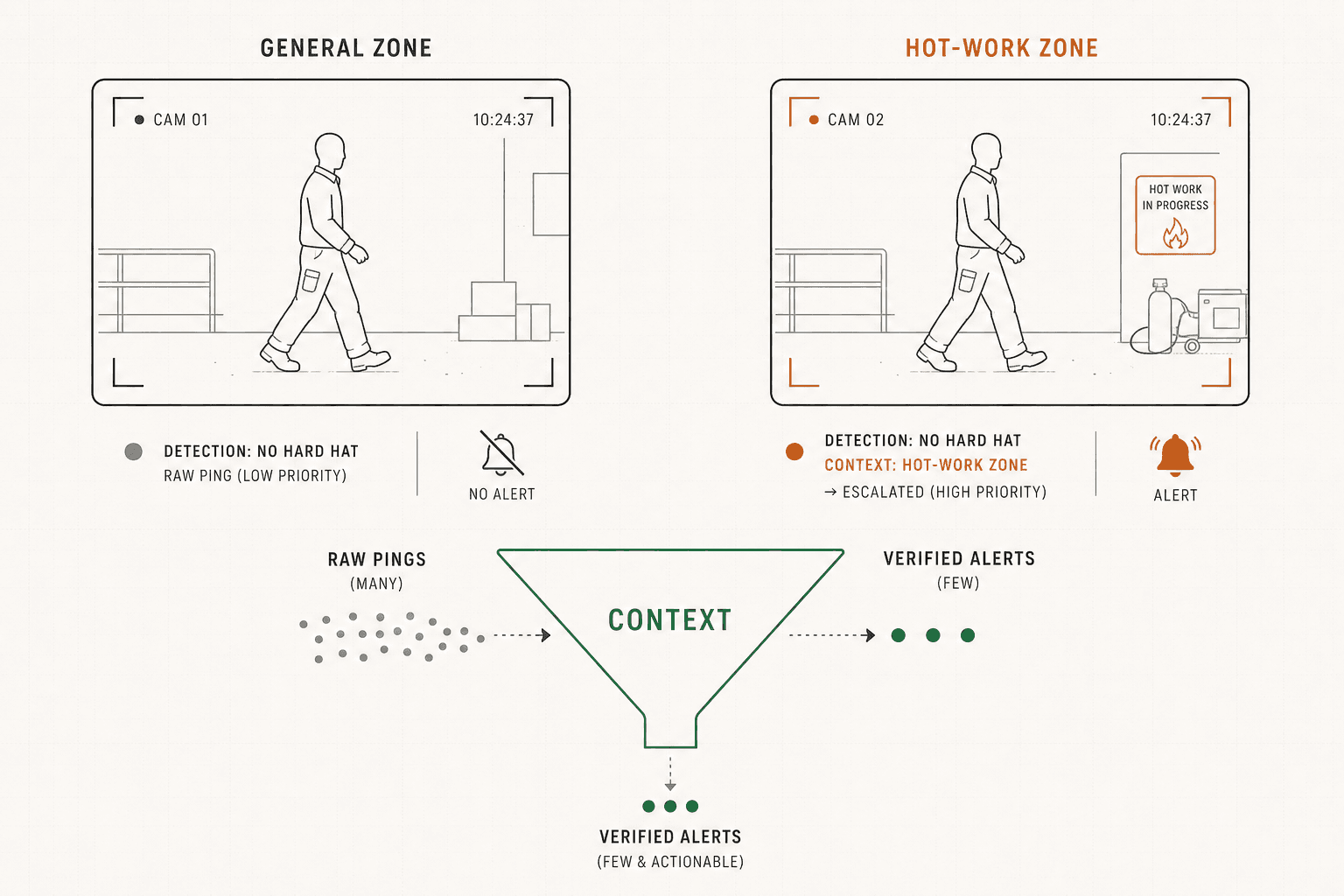
The single most powerful noise filter is knowing where a detection happened. A missing hard hat in a hot-work area is a serious event. The identical detection in a general zone may be nothing at all. Systems that let you draw camera-level zones (restricted, hazardous, hot-work, confined-space, general, muster) and attach PPE rules to each can enforce goggles in the welding bay, hard hats in the crane radius, and harnesses at height, each according to your actual safety program. The same bare head produces an alert in one polygon and silence in another. That is not a loss of sensitivity; it is the difference between signal and noise.
2. What it means: policy and severity
Not every real violation deserves the same response. A serious system combines the detection with your severity policy, so a minor lapse in a low-risk area is logged for the trend record while a person-down or a fire escalates immediately and loudly. Without this layer, everything arrives at the same volume, and uniform-volume alerting is functionally the same as no alerting: the important events drown in the unimportant ones.
3. Whether it can even see: visibility honesty
A subtle but decisive design choice: does the system guess when it cannot actually see? The most common source of false positives is a model asserting "no hard hat" when the truth is "the head is not visible in this frame." A well-built system checks whether the relevant body part is actually visible before making a compliance call, and stays silent when it is not. If the AI can't see it, it shouldn't alert on it. This one principle removes a large share of nuisance alarms on its own.
Where human review comes in
Context filters the noise; human review handles the residue. The strongest deployments route a short evidence clip for a person to confirm, dismiss, or escalate, and critically, they let that human judgment feed back into the record. Models propose, accountable people decide. This does two things at once: it keeps a person answerable for consequential calls, and it means the alerts that do reach the wider team have already survived a filter, so they carry weight. A team that knows every escalated alert was human-verified is a team that acts on alerts.
There is an organisational point buried here. Trust in a safety system is not a technical property; it is a social one. It is built by the system being right often enough that acting on it feels rational, and destroyed by it being wrong often enough that ignoring it feels rational. Context and human review are how you land on the right side of that line.
What to ask in a demo
When you are in a demo, the accuracy slide is the least useful thing on screen. Ask these instead:
- "Show me the same detection in two different zones." A context-aware system produces different outcomes. A raw detector produces the same alert twice.
- "What happens when the hard hat is out of frame?" You want to hear that it declines to guess, not that it assumes non-compliance.
- "How do I tune severity by zone and event type?" If everything is one alert level, expect alert fatigue.
- "What's the review workflow for a critical event?" You want a human gate on fire, spills, and person-down.
- "Can I see the false-positive rate on our own footage?" The honest answer is a pilot on your cameras, your lighting, your zones, not a number from someone else's site.
The bottom line
PPE detection is a solved problem in the narrow sense: the models can see the hard hat. What is not solved by the model, and what actually determines whether a safety system works in your facility, is the judgment about whether a given detection matters. That judgment comes from context: where the event happened, what your policy says about it, whether the system could even see clearly, and whether a human confirmed it before it reached your team.
Buy the context, not the accuracy number. The accuracy number is what gets you into the building. The context is what keeps your crew trusting the system long enough for it to prevent something.
MilkenLabs pairs continuous computer-vision detection with an understanding layer (zones, hazardous areas, hot work, closing-distance logic, facility policy) and human verification, so the alerts that reach your team are the ones worth acting on. Request a demo to see the false-positive rate on your own footage.