The Real Cost of a Preventable Incident: Building the Business Case for Safety Technology
Every safety investment eventually lands on someone's desk with the same question attached. What is the return? It is a fair question, and the honest answer is not that you cannot put a price on safety. You can, and the people who approve budgets are right to ask. The problem is that most business cases for safety technology price the wrong thing. They compare the cost of the software against the direct cost of an incident, when the direct cost is the smallest part of the picture.
This guide is for the operations and finance leaders who have to build or approve that case. It lays out the full cost of a preventable incident and how to think about the return on preventing it, without inflating anything.
Why the first invoice understates the loss
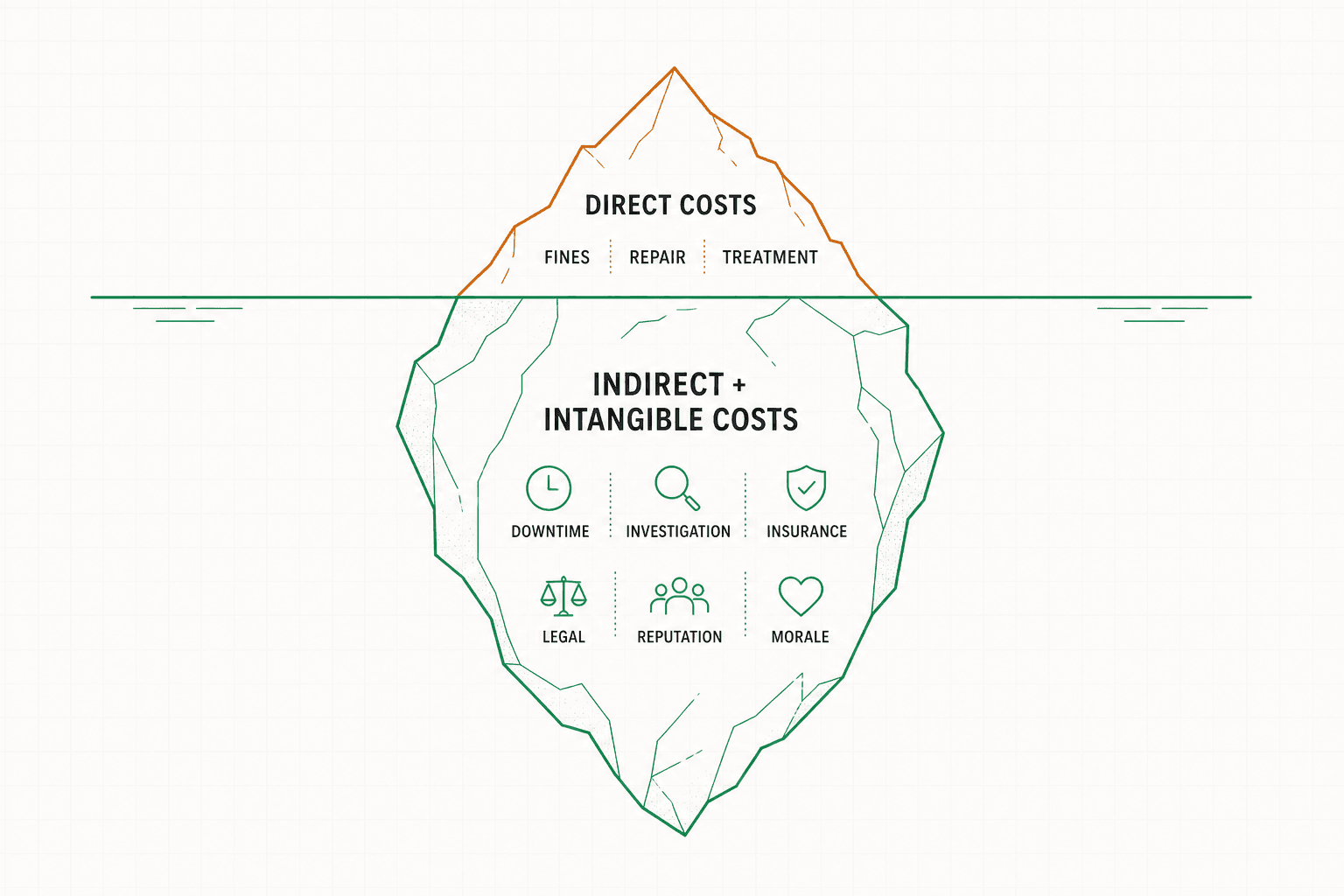
When a serious incident happens at a facility, the visible cost is only the tip. Medical treatment, immediate repair, the first regulatory fine. Underneath sits a much larger mass that rarely makes it into the headline number.
The direct costs are the ones everyone counts: treatment, compensation, equipment replacement, the fine or the clean-up bill. The indirect costs are larger and routinely undercounted: production downtime while operations stop, the investigation itself and the hours it eats, closer regulatory scrutiny that slows every future approval, higher insurance at renewal, legal exposure, and the cost of losing and retraining experienced people. There is also the management attention pulled away from actually running the business, which is real even though no one invoices for it.
Then there are the intangible costs, the hardest to measure and often the most damaging over time. Reputation with regulators, host communities and partners. The erosion of your social licence to operate. The quiet loss of morale in a workforce that no longer fully believes the operation is safe.
Safety research has held for a long time that the indirect and intangible costs of an incident are several times larger than the direct ones. You do not need a precise multiplier to use the point. You only need to stop pricing the whole thing by its tip.
Building a case that survives scrutiny
A credible business case avoids two temptations. The first is the vendor's habit of inflating the number of incidents prevented. The second is the sceptic's habit of counting only what appears on an invoice. Here is a structure that holds up in front of a finance leader.
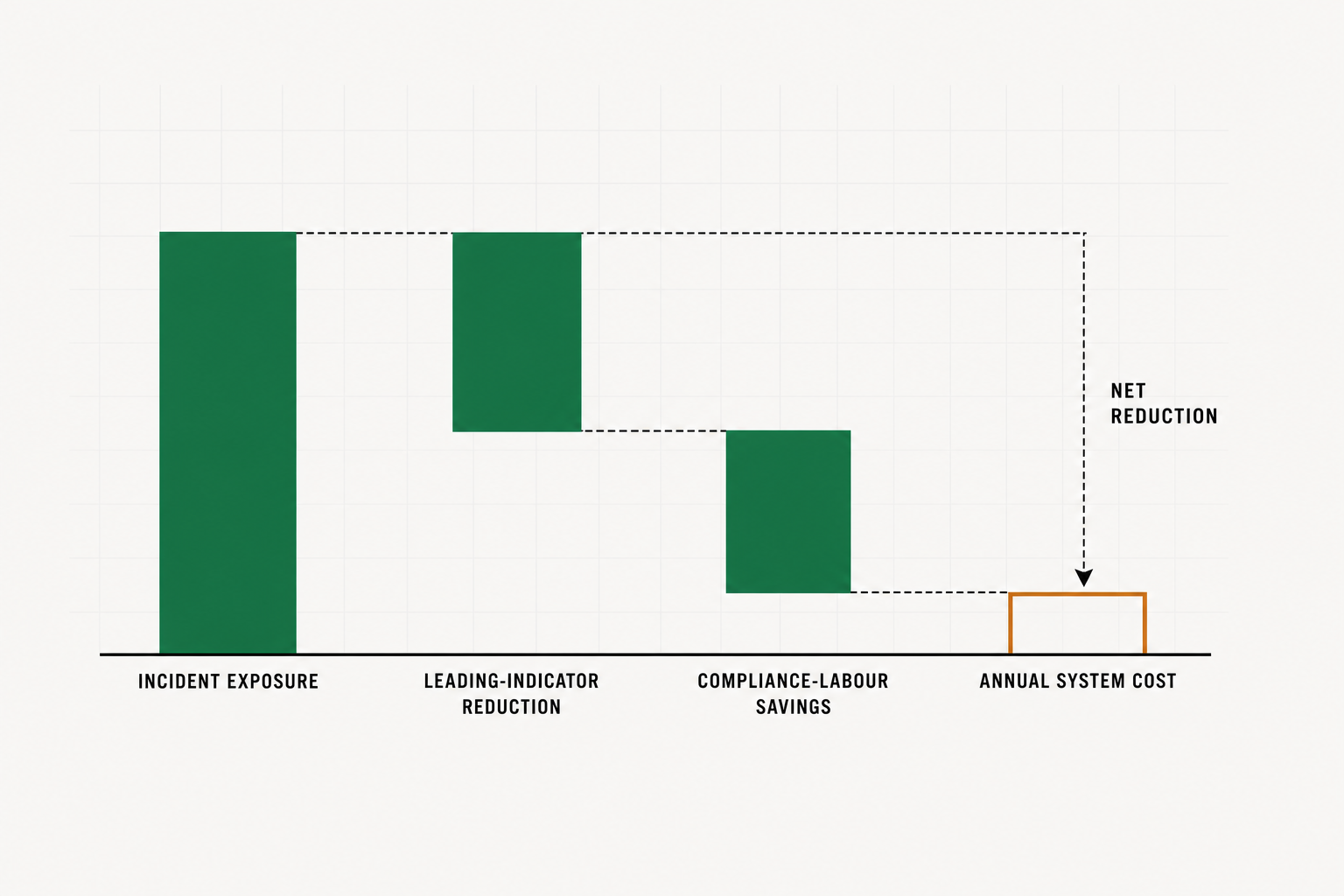
Start with your own baseline. Use your real incident and near-miss history, not industry averages. How many recordable incidents, near-misses and regulatory findings did you have across your facilities last year? What did the worst one actually cost when you add in the downtime and the investigation hours, not just the repair? This is your true exposure, and it is almost always higher than the figure on file, because the indirect costs were quietly absorbed by other budgets.
Next, price the leading indicators, not only the disasters. The events a monitoring system catches most often are not catastrophes. They are the PPE gaps, zone intrusions and unsafe-proximity moments that come before catastrophes. A well-supported safety principle holds that serious incidents are preceded by a large volume of small lapses and near-misses. Catching and correcting those routinely is how you reduce the rare, expensive event. So value the steady reduction in leading indicators, and treat a prevented major incident as upside rather than the base of your case.
Then count the efficiency gains you can bank no matter what. Some returns do not depend on preventing anything at all. If verified events pre-fill compliance records, you recover the hours your team currently spends reconstructing incident reports and assembling regulator packs. If a spill record that used to take days now assembles itself from a standing evidence base, that time saving is real and it repeats every reporting cycle. These are the most defensible lines in the whole model, because they land whether or not a major incident ever occurs.
Finally, frame the cost against exposure rather than against zero. Set the annual cost of the system against your fully loaded incident exposure plus those recurring compliance savings, not against a vague question of whether safety is worth it. When the comparison is the yearly cost of the system versus the fully loaded cost of a single serious incident at one facility, the ratio usually makes the argument for you, with no exaggeration required.
What not to claim
A business case that promises to eliminate incidents will not survive contact with an experienced operator, and it should not. No monitoring system removes risk. It moves you from investigating harm after it happens to stepping in before it does. The honest claim is narrower and stronger. You will catch more leading indicators earlier, correct more of them before they escalate, and spend far less effort proving compliance. Those three things, repeated across every facility and every shift, are what move your risk and your cost over time.
The honest version
The case for safety technology is not emotional, and it is not safety at any price. It is that the true cost of a preventable incident runs well past the first invoice, that the events which lead to those incidents can be caught, and that a large share of the return, the compliance-labour saving, is bankable regardless of what you prevent. Build the case on your own numbers, price the whole loss rather than the visible part, and let the comparison stand on its own. Decision-makers do not need to be sold on safety. They need an honest model, and honest models tend to favour prevention.
MilkenLabs helps operators catch leading safety indicators earlier and turn verified events into audit-ready records, reducing both incident exposure and the labour cost of proving compliance. Request a demo to model it against your own facilities.