Confined Spaces and Unsafe Proximity: Watching the Risks That Kill Most Often
Not all hazards carry the same weight. A missing hard hat in a walkway is worth correcting, but a worker entering an unmonitored tank, or standing in the swing radius of an excavator, is a very different kind of risk. In oil and gas, a small number of hazard types account for a large share of the deaths. Two of them, confined-space entry and unsafe proximity to moving equipment, share an awkward feature. They are extremely hard for a human supervisor to watch continuously, and they turn fatal fast when they are missed.
This guide looks at why these two risks resist normal supervision, and what continuous monitoring actually adds to the controls you already have.
Why these two are different
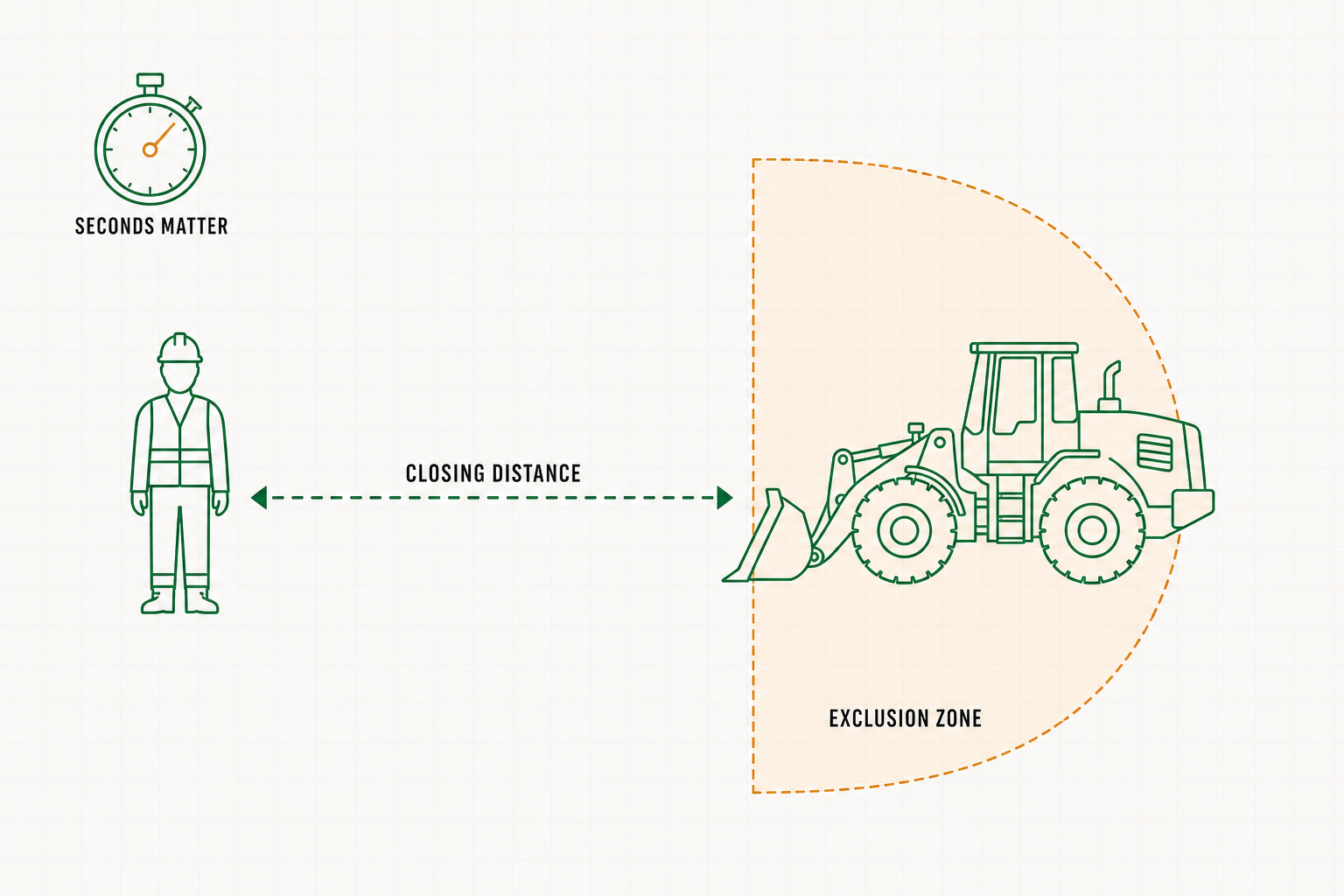
Most PPE violations give you time. A worker without gloves can be corrected on the next round. Confined-space and proximity hazards often do not offer that grace. The gap between an unsafe condition and a fatal outcome can be seconds, and by the time a person notices, it is frequently too late.
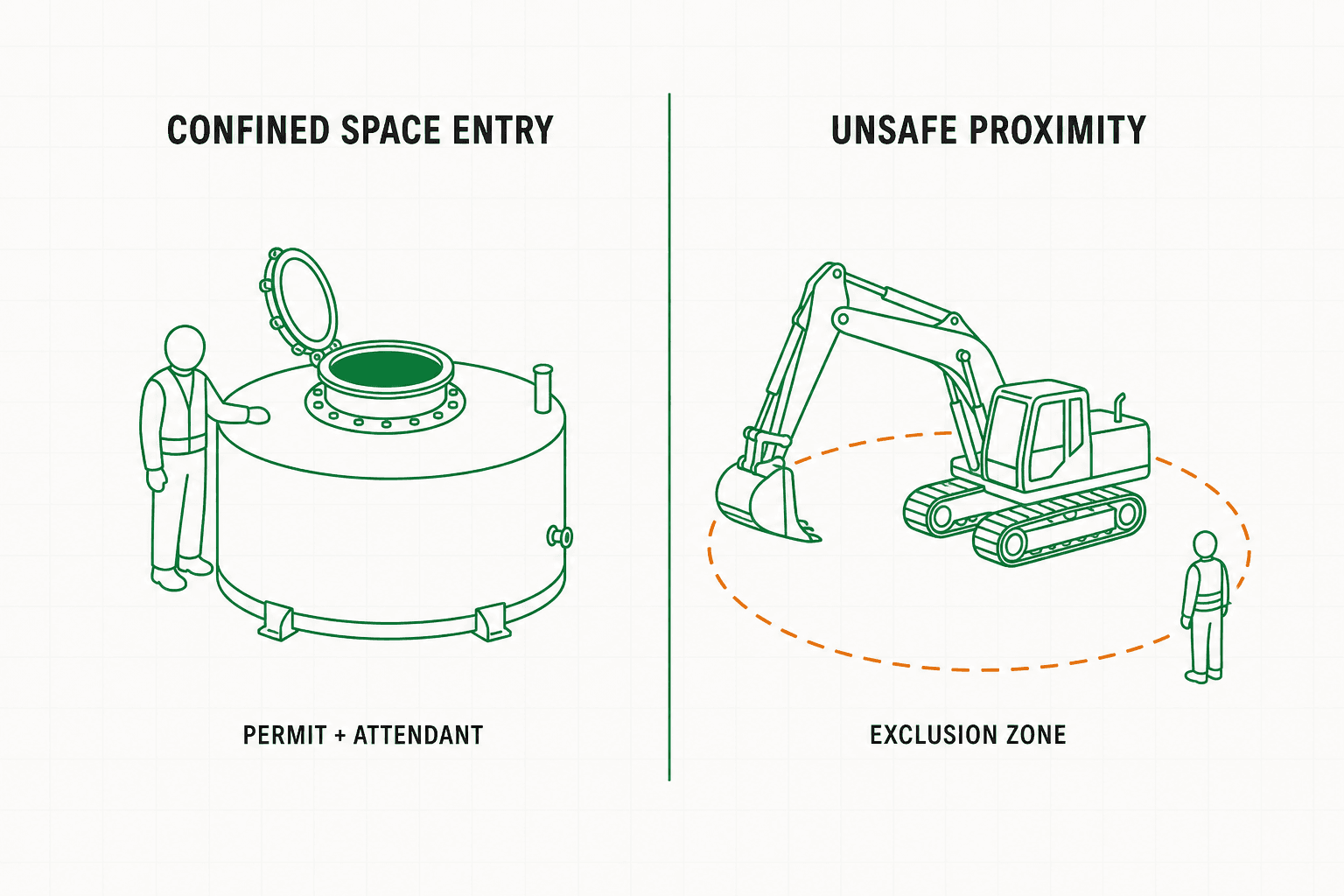
Confined spaces such as tanks, vessels, pits and sumps are dangerous because the threat is often invisible and the person is out of sight. The atmosphere inside can go from breathable to fatal with no visible warning. Anyone who enters is, by definition, in a place where they cannot easily be seen and where rescue is hard and hazardous. The recurring tragedy is the would-be rescuer who rushes in and becomes the second casualty. The controls are well understood: entry permits, atmospheric testing, and an attendant posted at the entrance. But they only work if they are followed every single time, and the failures are usually procedural. An unauthorised entry, an entrance left unattended, a permit skipped under time pressure.
Unsafe proximity is the struck-by and caught-between family of accidents, and it comes from people and heavy moving equipment sharing the same space. Cranes, excavators, vehicles, loads under lift. The danger here is dynamic, changing moment to moment as machines and people move around each other. A blind spot, a swing into an occupied area, a worker walking under a suspended load. These situations develop in real time and depend on spatial awareness that no supervisor watching a bank of screens can hold across a whole site at once.
Why people cannot watch this reliably
Both risks defeat human watching for the same handful of reasons. There is simply too much to watch at once, and one supervisor cannot hold a dozen feeds and a live site in their attention at the same time. The critical moment is brief, sometimes only seconds. Human vigilance also decays, and we are measurably poor at staying alert to quiet feeds where nothing has happened for a long time, which is exactly when the one thing that matters finally does. And the highest-risk moments are often the ones no one is looking at, since the confined space is monitored precisely because it sits outside normal sightlines.
None of this is a criticism of supervisors. It is just an honest recognition that continuous, unbroken spatial attention across many locations is not something people are built to sustain. It is, however, something a machine does well.
What continuous monitoring adds
An AI layer on your existing cameras does not replace permits, attendants or atmospheric testing. Those controls stay essential. What it adds is a tireless second watch on the conditions those controls depend on.
For confined spaces, the system can watch entry points around the clock and flag an entry that does not match your policy. An entry into a permit-required space with no attendant present, or an entry outside an approved window. It never looks away from the entrance, never gets bored, and raises the alarm the moment the picture stops matching the permit. The attendant is still posted. The system is the backup that notices if they step away at the wrong moment.
For unsafe proximity, this is where machine vision has a real edge over human eyes. The system can reason about distance and motion. The closing gap between a person and a moving machine, an intrusion into an equipment exclusion zone, a person in a marked danger area while a lift is active. It can alert in the seconds that matter. Zone rules let you enforce an exclusion around active equipment automatically, so the swing radius is watched continuously rather than relying on everyone's spatial awareness holding at the same time.
Work at height belongs to the same high-consequence group. The same approach flags a worker at height without the expected fall protection in the moment, rather than in the incident report afterward.
Context still decides
As with all safety AI, the value lies in context, not in raw detection. A person near equipment that is powered down is not the same as a person near an active lift. A confined-space entry with a permit and an attendant is compliant, while the identical entry without them is an emergency. A system worth deploying understands the difference, combining what it sees with zones, equipment state and your permit policy, so that what reaches your team is a real high-consequence event and not noise. And because these are the most serious events, they should escalate loudly and go to a human at once, never sit quietly in a log.
Why this one matters
Confined-space and proximity hazards deserve special attention because they are both high-consequence and hard to supervise. The moments are brief, the victims are often out of sight, and human vigilance is weakest exactly where these risks are highest. Continuous monitoring does not replace the permits, attendants and exclusion zones that keep people safe. It makes them more reliable by adding a watch that never blinks and never tires, aimed at the risks where a single missed moment is measured in lives. For an HSE manager, that is the difference between hoping every control is followed every time and knowing you will be told the instant one is not.
MilkenLabs watches confined-space entries, equipment exclusion zones, unsafe proximity and work at height in real time on your existing cameras, with context, human verification and an audit trail. Explore capabilities or request a demo.
This article discusses safety-critical hazards in general terms and is not a substitute for a qualified confined-space or lifting-operations program.