Buy or Build: Should You Develop Safety AI In-House?
Any operator with a capable data team eventually asks the question, and they are right to ask it. The models are more open than they used to be, we already have the cameras, so why not build PPE detection ourselves? It is a legitimate question, and the answer is not automatically to buy. This guide gives you an honest way to decide, written for the technical and operations leaders who would own the result either way.
The goal here is not to talk you out of building. It is to make sure that if you build, you do it with the full cost in view. The demo is easy and the finished system is hard, and the space between them is where most in-house safety AI projects quietly stall.
Why building looks easy at first
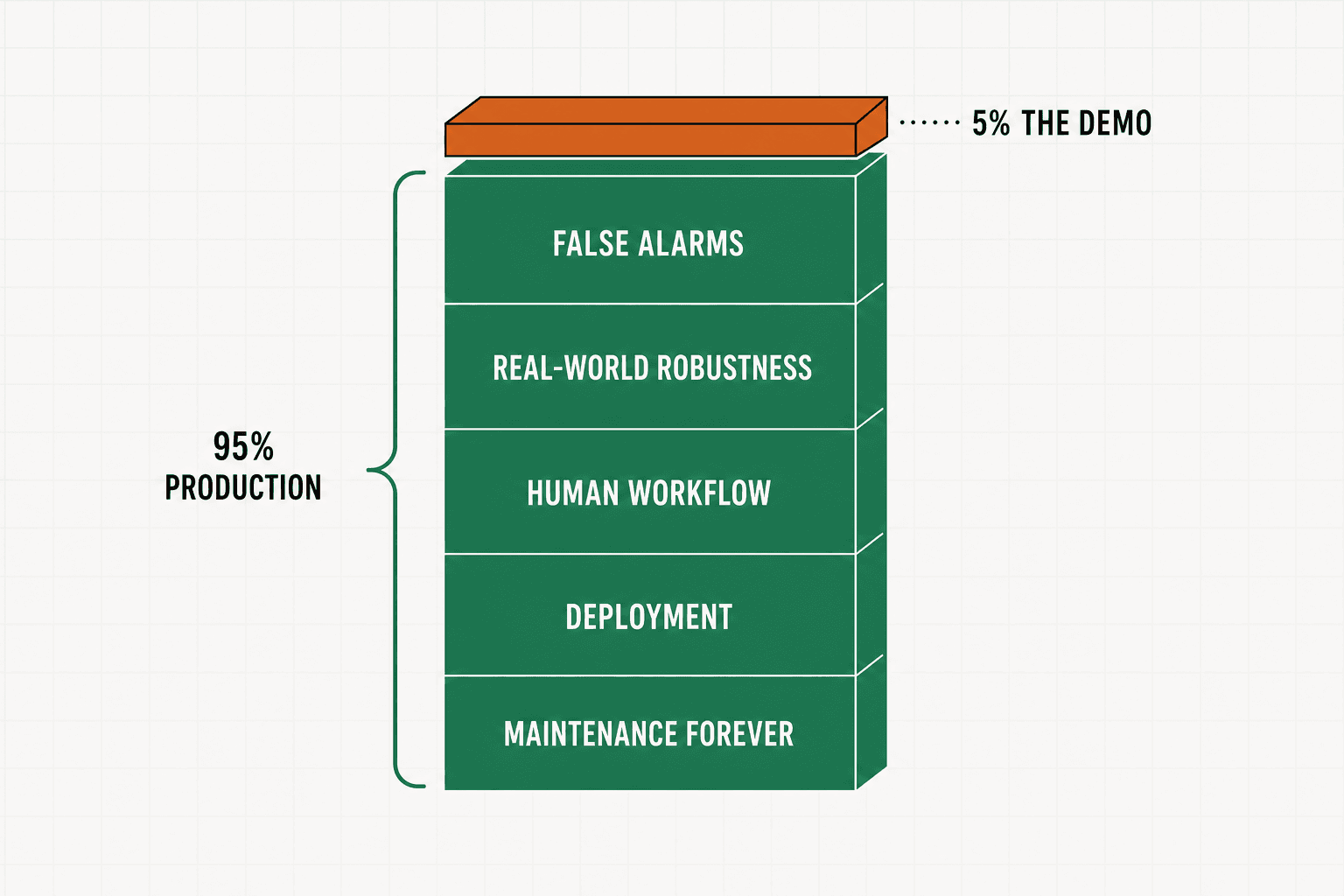
Standing up a proof of concept that spots hard hats in a video feed is genuinely a weekend job now. Pre-trained models are available, the tutorials are good, and the first demo will impress a room. That is exactly the trap. The demo is about five percent of the work, and it is the easy five percent.
The hard part is everything between "it detects a hard hat in a clean clip" and "an operations team trusts it enough to act on it across every shift, at every facility, in real conditions." That gap is made of problems that never show up in a demo.
The first is false alarms. Raw detection is not really the problem. Context is. Building the zone logic, the severity rules and the honesty to stay quiet when the system cannot actually see a worker's head is a large and ongoing engineering effort. Skip it and your crews stop trusting the alerts within weeks, and the whole investment is wasted.
The second is real-world robustness. Your facilities have dust, glare, rain, night shifts, odd angles and people half-hidden behind equipment. A model trained on clean data degrades in those conditions. Holding accuracy means retraining regularly on your own footage, which needs a labelling operation, a retraining pipeline and someone who owns model performance as a full-time job.
The third is the human workflow. A detection is not a safety system. You need a review queue, an escalation path, an audit trail, and a way for verified events to become compliance records. That is a software product, not a model.
The fourth is deployment. Running inference on-site, at remote facilities, on infrastructure that can be air-gapped, inside a cautious OT security review, is a serious systems problem that is separate from the data science.
The fifth is maintenance, forever. Models drift, cameras change, regulations update, and the people who built it move on. An in-house system is not a project you finish. It is a team you fund indefinitely.
The honest cost of building
The sticker cost of building is "we already have a data scientist." The real cost is a standing, multi-skilled capability: computer vision engineering, data labelling, model operations and retraining, edge and systems engineering, and product work for the review and reporting side. On top of that sits the opportunity cost of pointing that talent at safety plumbing instead of at your core business.
For most operators the core business is producing hydrocarbons safely, not running a machine-learning platform. Every hour your best engineers spend keeping a detection pipeline alive is an hour not spent on the thing only your company can do.
When building actually makes sense
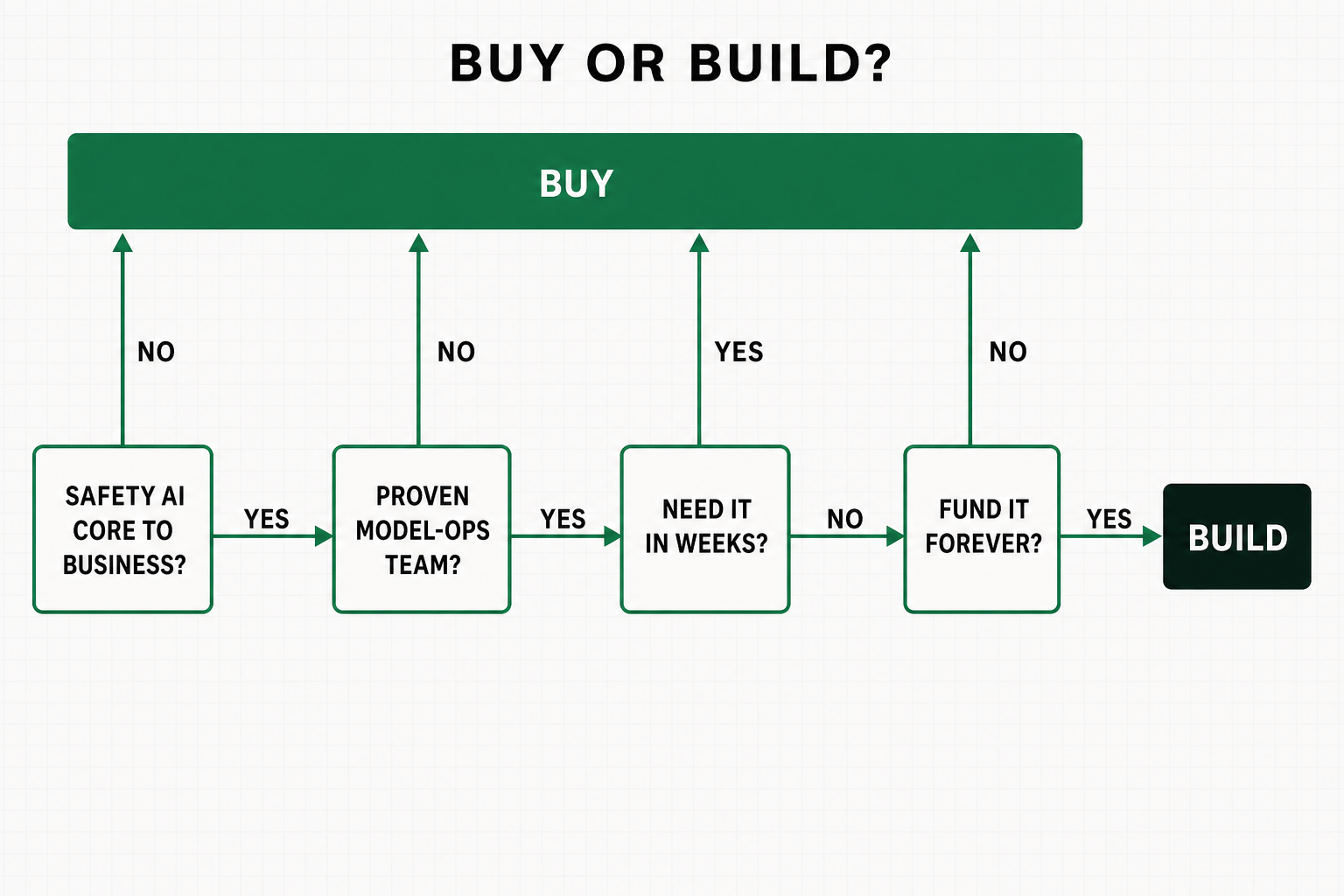
This is not a one-sided case. Building can be the right call in a few situations. It makes sense when safety AI is strategically core to your business rather than a supporting function, for instance if you plan to productise and sell it yourself. It makes sense when you have genuinely unusual requirements that no external system can meet, and those requirements are stable enough to justify a permanent team. It makes sense when you already run a mature, well-staffed model operation with spare capacity and a track record of keeping production models healthy. And it can make sense when data-sovereignty rules genuinely forbid any external component, though a well-built bought system that runs air-gapped, with raw video never leaving your network, usually answers that concern without the build burden.
If two or more of those are true, building may be rational. If none are, building usually means paying full price to reinvent a system that someone else would maintain for you.
When buying is the stronger call
Buying tends to win when safety is mission-critical but is not your product, when you want value in weeks rather than quarters, when you need the false-alarm and deployment problems already solved, and when you would rather your engineers worked on your business. The real advantage of a mature bought system is not the model. It is everything around the model that took someone years to get right and that you would otherwise rediscover the hard way.
Four questions to settle it
Ask four questions honestly. Is safety AI core to our business or supporting? Do we have a proven model-operations team with spare capacity? How quickly do we need it working across all facilities? Can we fund it forever, not just build it once? If your answers lean toward supporting, no, soon and no, you are looking at a buy. If they pull toward build on real strategic grounds, then build with your eyes open and budget for the ninety-five percent, not the five.
Where this leaves you
The buy-or-build question is really a question about where your engineering talent creates the most value. Building safety AI is entirely possible. The barrier is not capability, it is the permanent cost of owning the unglamorous ninety-five percent that turns a detection demo into a system people trust. For most oil and gas operators that cost is better carried by someone whose whole business is getting it right, which leaves your own team free to do the work that is actually yours.
MilkenLabs is the built-and-maintained option, with false-alarm handling, edge deployment, human review and compliance records already solved, running on the cameras you own. Request a demo to compare it honestly against building it yourself.