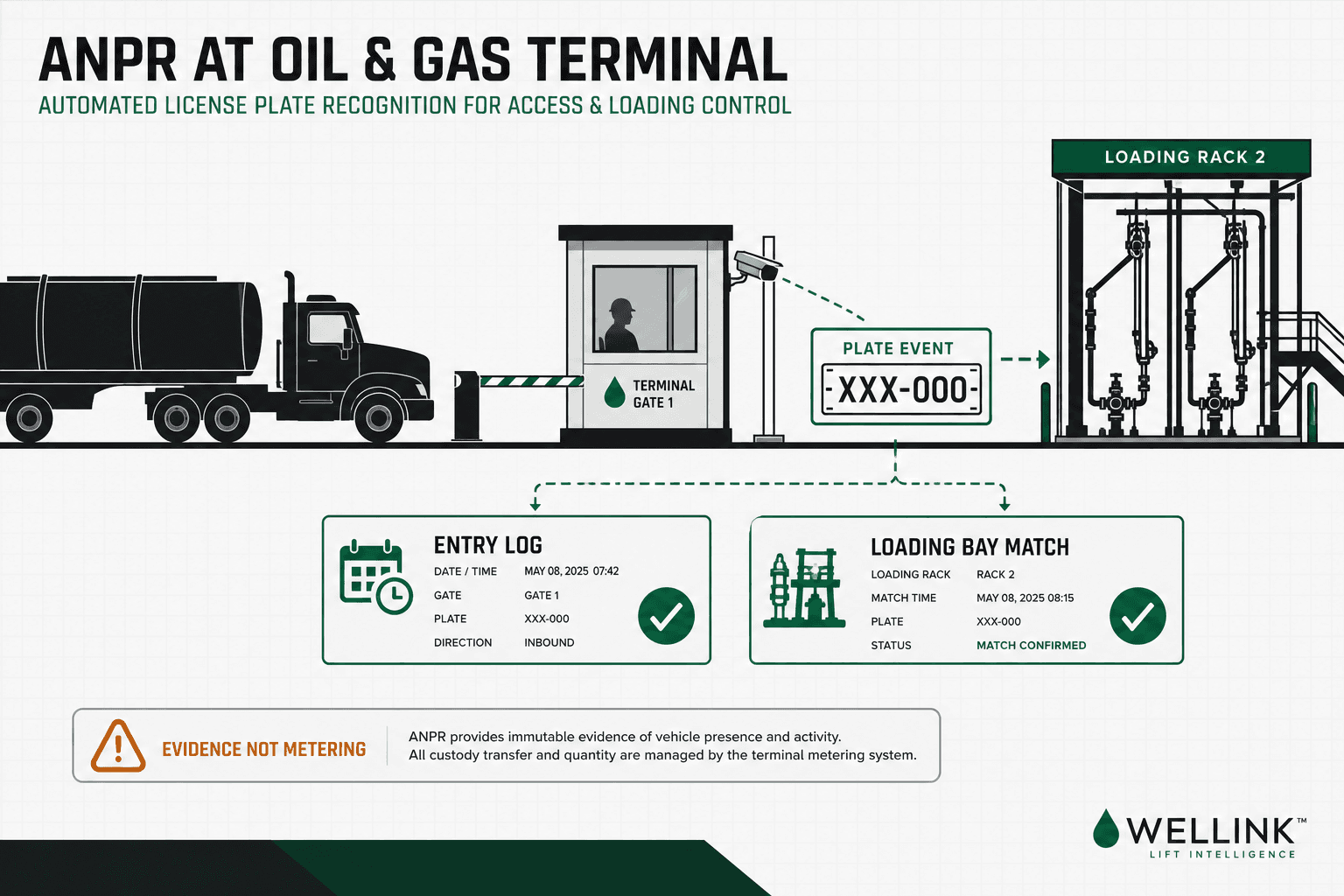
ANPR and Vehicle Identity at Terminals and Loading Racks: Evidence, Not Metering
At a busy Nigerian depot or export terminal, vehicles are not a side detail. They are the work. Tankers, contractor trucks, escort vehicles, and staff cars move through gates and loading racks on schedules that Security, Operations, and HSE all feel when something slips. Automatic number plate recognition, or ANPR, is often sold as if it were a complete answer. It is not. Used well, it is a strong evidence layer for vehicle identity at the places you already watch. Used badly, it gets confused with custody transfer, metering, or access control hardware it was never meant to replace.
This guide is for leaders who want vehicle identity they can defend in an investigation, without overclaiming what a camera can prove about product movement.
The real job: who was where, when
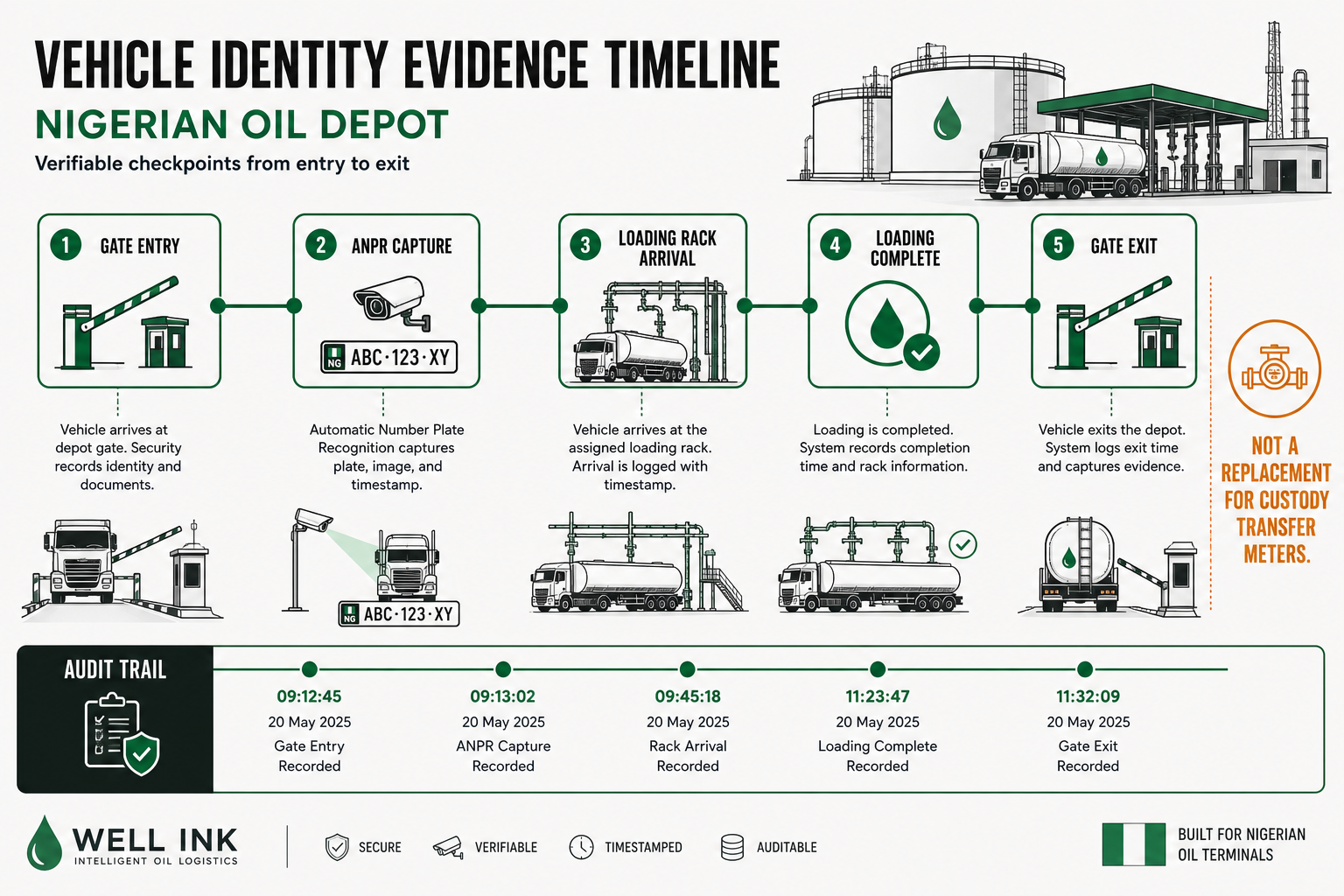
After a loading dispute, a security incident, or a near-miss in the rack lane, the first reconstruction questions are usually the same. Which vehicle entered? Which bay did it approach? How long did it dwell? When did it leave? Was it the same plate at the gate and at the rack?
Those questions are about identity and timeline, not litres through a meter. ANPR on existing gate and rack cameras can help answer them when treated as structured evidence: plate event, timestamp, camera location, short clip, human confirmation where the call matters. That package is useful to Security for unauthorized or unexpected vehicles, to Operations for queue and bay discipline, and to HSE when a vehicle event sits next to a pedestrian near-miss or a blocked egress path.
The high-value placements are narrow and familiar.
Main inbound and outbound gates. Capture identity at the controlled boundary, aligned with your existing gate process rather than inventing a parallel one.
Loading rack approaches and bay faces. Match the vehicle that entered with the vehicle that presented at the rack, so "it was a different truck" is something you can check instead of argue.
Holding yards and secondary exits. Spot vehicles that leave the expected path, linger where they should not, or appear at a rarely used exit after hours.
In each case the camera is doing identity and presence work. Access decisions should still sit with your gate procedures, badges, permits, and people. Analytics can flag a mismatch or an unexpected plate. They should not silently open a boom because a model felt confident.
Evidence, not metering
Custody transfer and product accounting live in meters, seals, tickets, and procedures built for that purpose. Confusing ANPR with that stack creates both operational and legal risk. A plate read does not prove what was loaded. A timeline of vehicle presence does not replace a calibrated meter ticket. The honest positioning is simpler and stronger: ANPR supports who was at the gate and rack, and when. Product quantity remains a metering and custody problem.
That clarity also helps the buying conversation. Security teams evaluating vehicle identity should not be forced into a metering RFP. Operations teams buying rack throughput tools should not be sold camera accuracy as if it were metrology. Keep the jobs separate and the evidence stays trustworthy.
What keeps ANPR useful, not noisy
Plate recognition in the real world faces dust, glare, night lighting, dirty plates, trailers, and awkward angles. A deployment that only celebrates demo-day reads will frustrate a Nigerian terminal within weeks. The practical design choices look like the rest of serious CCTV intelligence.
Context before alarm. A known contractor plate in the inbound lane at the booked window is information. The same plate at a pedestrian gate at 03:00 is an event. Unknown plates need a different severity than known ones, and dwell rules matter as much as the read itself.
Human confirmation on consequential calls. When an alert might stop a truck, escalate security, or enter an investigation file, a person should confirm the clip. Models propose. Accountable staff decide.
On-site processing and local video. Terminal layouts and vehicle movements are sensitive. Edge inference with raw video staying on the operator network by default fits cautious OT and security reviews better than shipping continuous gate video to a third-party cloud.
Honest limits. Missed reads and uncertain reads will happen. A good system says when it is unsure instead of inventing certainty. That honesty preserves trust the same way visibility checks do for PPE detection.
One vehicle story for three teams
The same plate event can feed three desks without becoming three systems. Security uses it for unauthorized or unexpected vehicles and for post-incident timelines. Operations uses dwell and bay match data to understand queue behaviour and rack congestion. HSE links vehicle presence to pedestrian conflict zones, blocked pathways, and loading-bay near-misses. The shared requirement is a consistent evidence object: time, place, plate (or failed read), clip, and review outcome.
When that object is the same across sites, a regional lead can compare gate discipline at multiple depots without each facility inventing its own spreadsheet language. That is portfolio value, not vanity analytics.
A sober checklist
Ask vendors and internal teams the same questions. Does ANPR run on the cameras we already have at gates and racks, or does it require a rip-and-replace project? Is the output framed as identity evidence, or is it being sold as metering? What happens on a failed or low-confidence read? Who confirms before escalation? Where does raw video live? Can the same event appear in Security and Operations workflows without duplicate databases? Can it run when connectivity is poor?
The answers tell you whether you are buying a thought-through facility layer or a plate demo.
Keeping ANPR in its lane
At Nigerian terminals and loading racks, ANPR is most valuable when it stays in its lane: vehicle identity and timeline evidence at gates and bays, reviewed by people, kept as audit-ready records. It does not replace custody transfer meters, and it does not replace gate judgment. Used with context, human review, and clear scope, it gives Security, HSE, and Operations a shared answer to who was where, when, which is often the missing piece when something preventable becomes an investigation.
MilkenLabs provides facility CCTV intelligence for oil and gas sites, including ANPR at gates and loading racks as part of a Security pack that sits alongside HSE and Operations detections on existing cameras. Explore capabilities or request a demo.