AI Safety Monitoring in Sub-Saharan Africa: Building for Remote Sites, Air-Gapped Networks, and Local Regulation
Most of the AI safety monitoring software on the market was built somewhere else, for somewhere else. The reference customer is a well-connected facility in a region with a mature, Western regulatory regime: OSHA in the United States, the EU's frameworks in Europe. The product assumptions follow from that: reliable bandwidth, cloud-first architecture, and compliance modules pre-loaded with OSHA log formats and EPA reporting.
Deploy that same product at a flow station in the Niger Delta and the assumptions start breaking one by one. This article is about what AI safety monitoring actually has to handle to work in Sub-Saharan Africa, and why the differences are structural, not cosmetic.
You cannot assume connectivity
A cloud-first safety system has a hidden dependency: a fat, reliable pipe to the internet. Many oil and gas sites across the region are remote, and connectivity is intermittent at best. A system that has to ship video to the cloud for analysis and wait for a result back is a system that goes blind exactly when the link drops, which, at a remote site, is often.
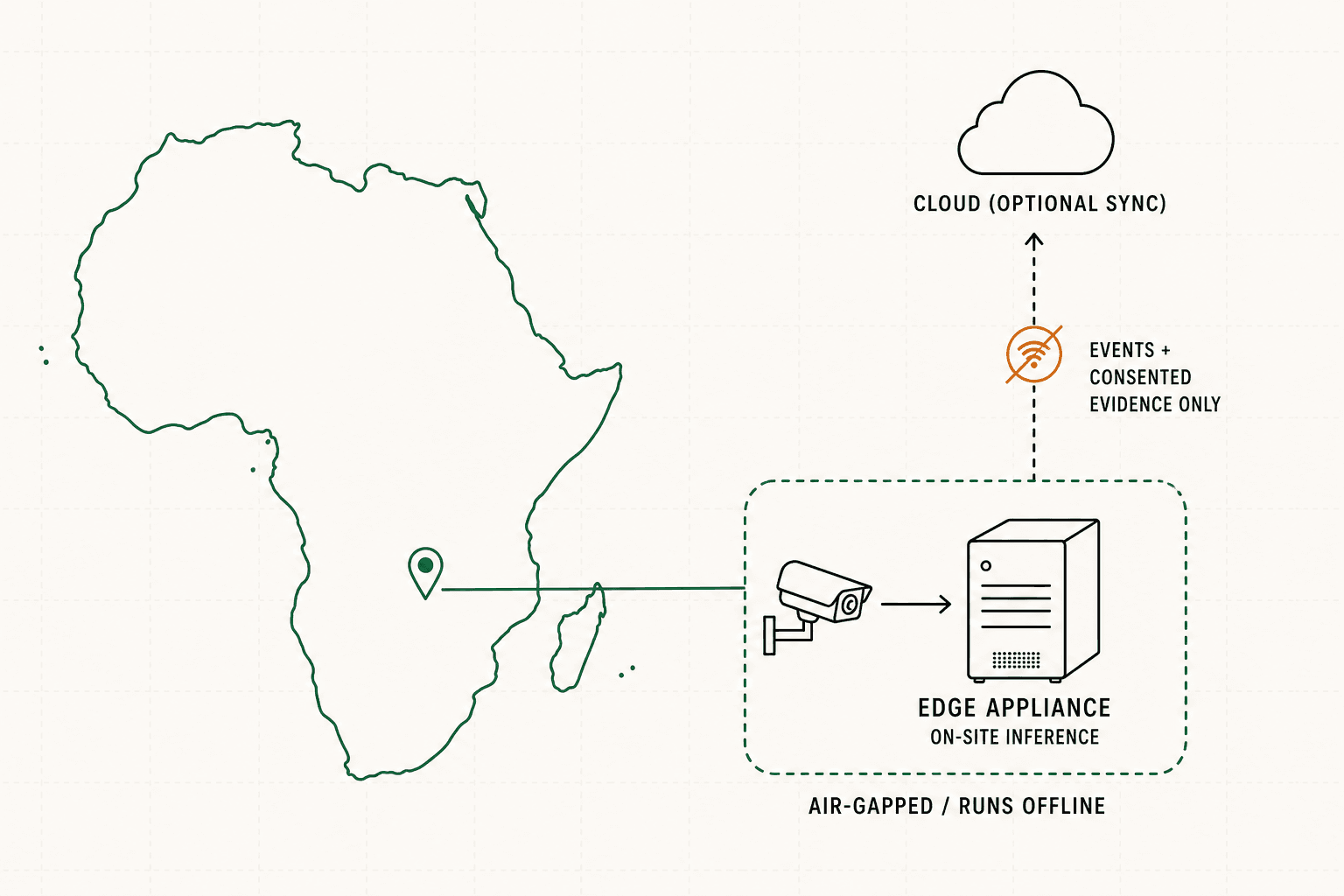
The architectural answer is edge inference: the detection runs on an on-site appliance, in real time, regardless of whether the internet is up. Alerts fire locally with no cloud round-trip and no latency penalty. When connectivity is available, dashboards, reporting, and fleet management sync, but the safety function never depends on the link being live. For a remote African site, "works fully offline, syncs when it can" is not a nice-to-have. It is the difference between continuous protection and a system that protects you only when the network cooperates.
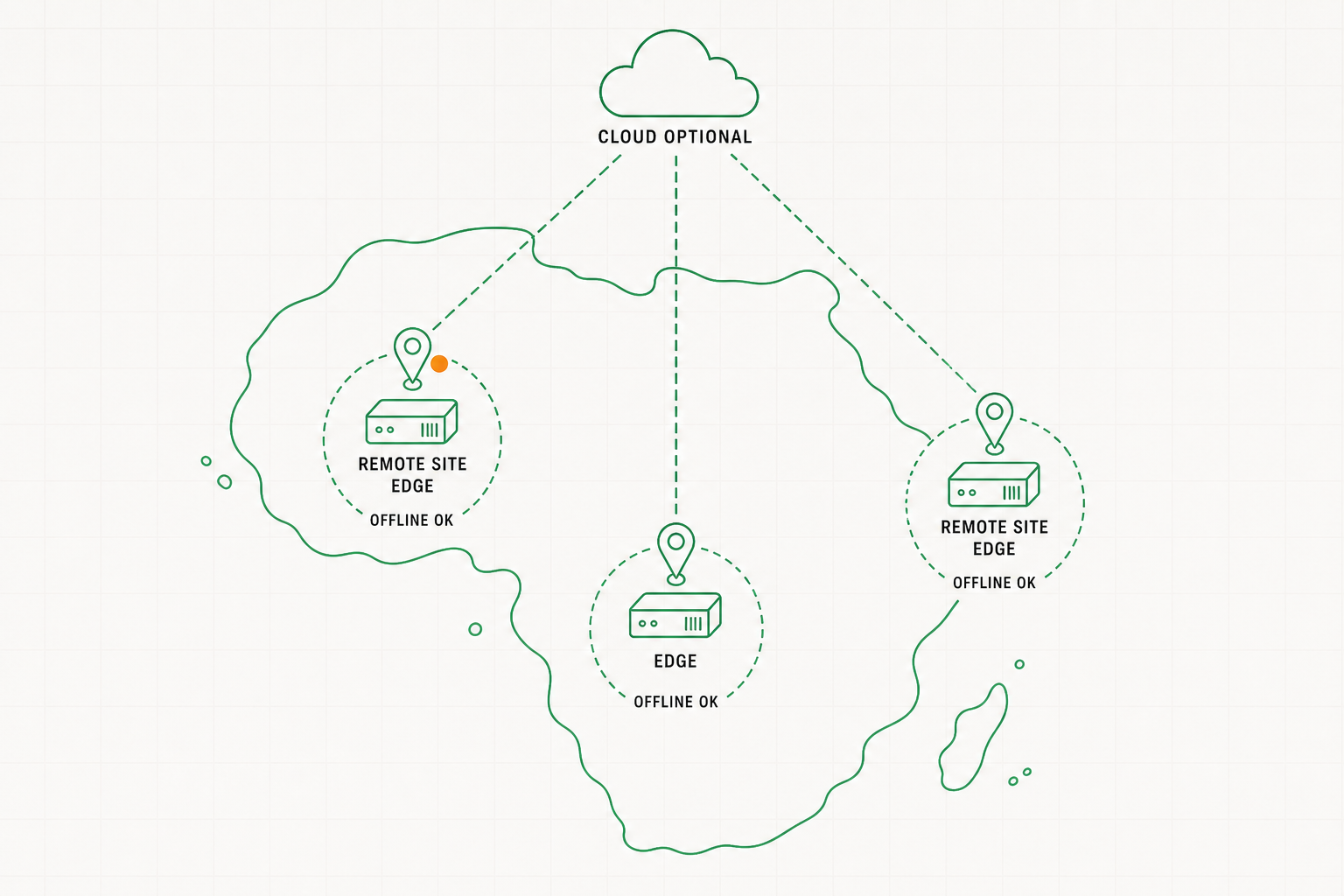
There is a cost dimension too. Shipping continuous video to the cloud burns bandwidth that is expensive and scarce. Processing on-device and sending only events and consented evidence, not raw streams, cuts that cost dramatically.
OT security teams will push back, rightly
Oil and gas operators run safety-critical operational technology, and the people who sign off on connecting anything to it are, correctly, cautious. A vendor asking to route raw footage of the operation off-site, into their cloud, will meet a hard security review, and often a "no."
Building for this environment means designing so that raw video never has to leave the operator's network by default. Video ingestion and inference run on-site. Only structured events, metadata, and explicitly consented evidence ever sync outward, and only where the operator permits. The system should be able to run fully air-gapped for the most conservative sites. This is not a feature you add later; it is an architecture you commit to up front, and it is one of the clearest tells of whether a product was designed with these buyers in mind.
Workforce privacy belongs in the same conversation. Where the system touches worker identity at all, it should be consent-gated (people who opt out are excluded from matching), and every compliance-relevant action should be attributable. Safety enforcement is about what is being worn in which zone, not surveillance of individuals, and the design should reflect that.
The regulator is not the EPA
This is the difference that pre-loaded global products simply cannot paper over. An operator in Nigeria does not answer to OSHA and the EPA. They answer to NOSDRA on spills, to the NUPRC and NMDPRA on petroleum regulation, to the Federal Ministry of Environment, and to a host-community framework with its own obligations. The reporting artifacts are different: a NOSDRA spill record and the Joint Investigation Visit process have no equivalent in a US-templated compliance module.
A safety system built for the region produces the local record natively. When a verified spill or incident becomes a compliance draft, that draft should map to the record the Nigerian regulator actually requires, pre-filled with linked evidence, not to a form designed for a different jurisdiction that someone then has to manually translate. Compliance that is native to where you operate is not an afterthought bolted onto a global core; it is something the system produces because it was built here.
The environment is harder on everything
The physical conditions are less forgiving: heat, dust, variable light, hazardous zones. Detection models have to hold accuracy across those conditions rather than degrading the moment the lighting is not studio-clean. And the buyer is, rightly, conservative: in a safety-critical setting, a false alarm erodes hard-won trust, and a missed event is unacceptable. A system built for the region has to respect both sides of that at once: quiet enough to be trusted, sharp enough to be relied on.
What this adds up to
Put these realities together and you get a specific product shape, one that looks quite different from the global default:
- Asset-light, running on the cameras and infrastructure operators already own, because rip-and-replace does not survive the budget or the security review.
- Edge-first, so safety runs on-site and offline, with the cloud as an optional sync rather than a dependency.
- Air-gap-capable, with raw video staying on the network by default and only events and consented evidence leaving.
- Regulation-native, producing NOSDRA and other local records as first-class outputs.
- Robust to the environment, holding detection quality across real African site conditions.
None of these is a marketing preference. Each one falls out of taking the operating reality seriously. A product that was built for reliable bandwidth and OSHA can be sold into the region, but it will keep bumping into the places where its assumptions do not hold. A product built here starts from those constraints.
The question worth asking
The question for an HSE leader evaluating safety AI in Sub-Saharan Africa is not "is this a good product?" It is "was this built for where I actually operate?" Ask where inference runs when the internet is down. Ask what leaves your network. Ask whether it can run air-gapped. Ask whether it produces a NOSDRA record or an OSHA one. The answers will tell you quickly whether you are looking at a system designed for your reality, or one designed for someone else's, hoping yours is close enough.
MilkenLabs is the first integrated HSE intelligence system built for Sub-Saharan Africa: edge-first, air-gap-capable, running on existing CCTV, with compliance produced natively for the regulators you actually answer to. Request a demo or explore capabilities.